
Documents & tools · Motor-based intervention
Connecting the Dots
Plan motor-based therapy with the principles of motor learning. Start with one child, find where they are on the path from acquisition to learning, and leave with a plan for practice, cueing and feedback. Every suggestion links back to a principle.
The companion to Nicole's invited session at ASHA 2026, with Pooja Aggarwal. The planner is free.
Connecting the Dots Planner
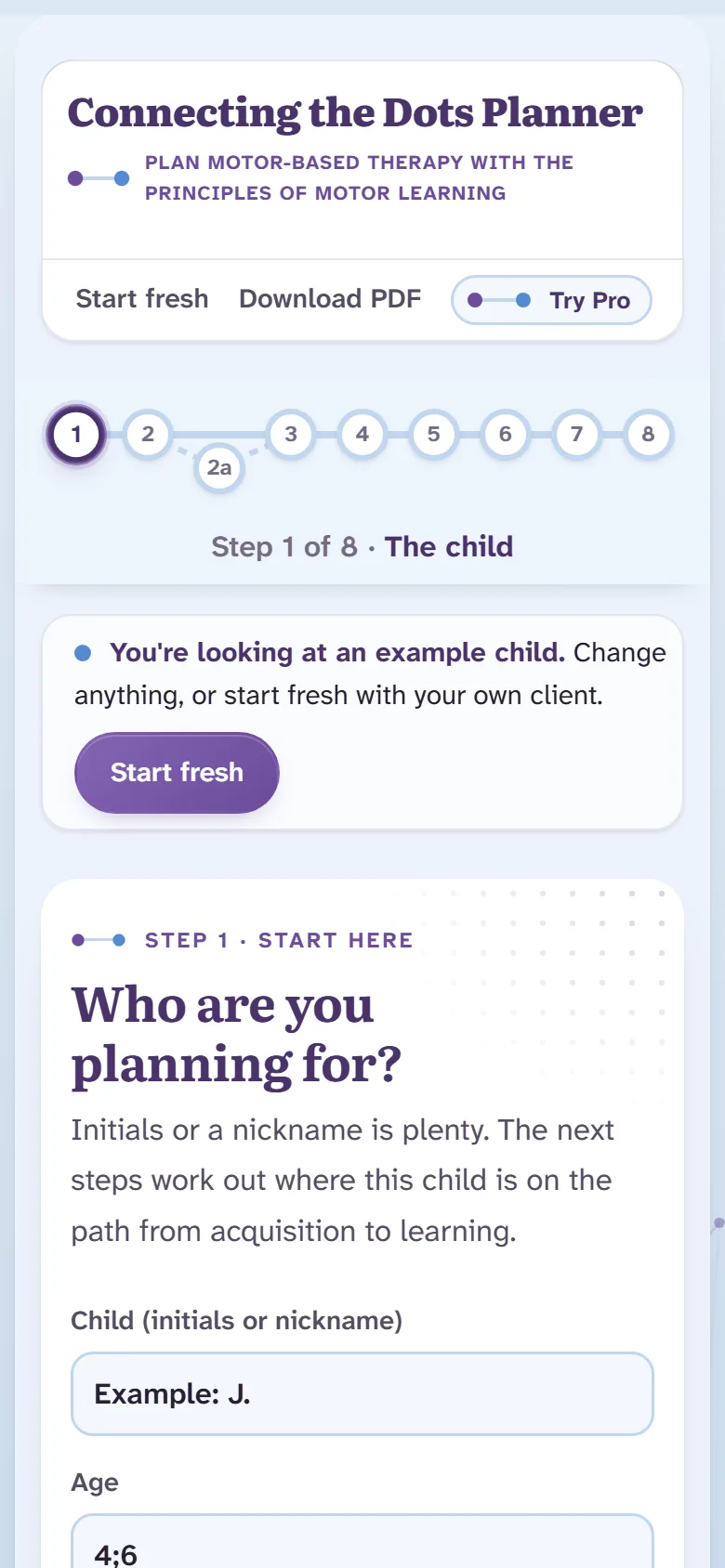
One child, eight steps
Know where to start
Choices that fit the stage
A principle behind every choice
Leave with a plan you can print
Use it in your browser
Two ways to use it
The free planner works on any phone or computer with no account. Connecting the Dots Pro adds a secure home for your caseload, session tracking and your team.
-
FreeNo accountPDF
Connecting the Dots Planner
Walk through eight steps for one child: readiness, the learning stage for each target, practice conditions, cueing and feedback. Download a filled-in PDF of the plan when you're done. Your entries stay in your browser.
-
For practices and teamsHIPAA
Connecting the Dots Pro
Everything in the planner, plus every child in one secure place.
- Track every trial in session
- Every session and plan version kept
- Mentor and supervisor notes right on the step
- HIPAA protections
How it works
The eight steps
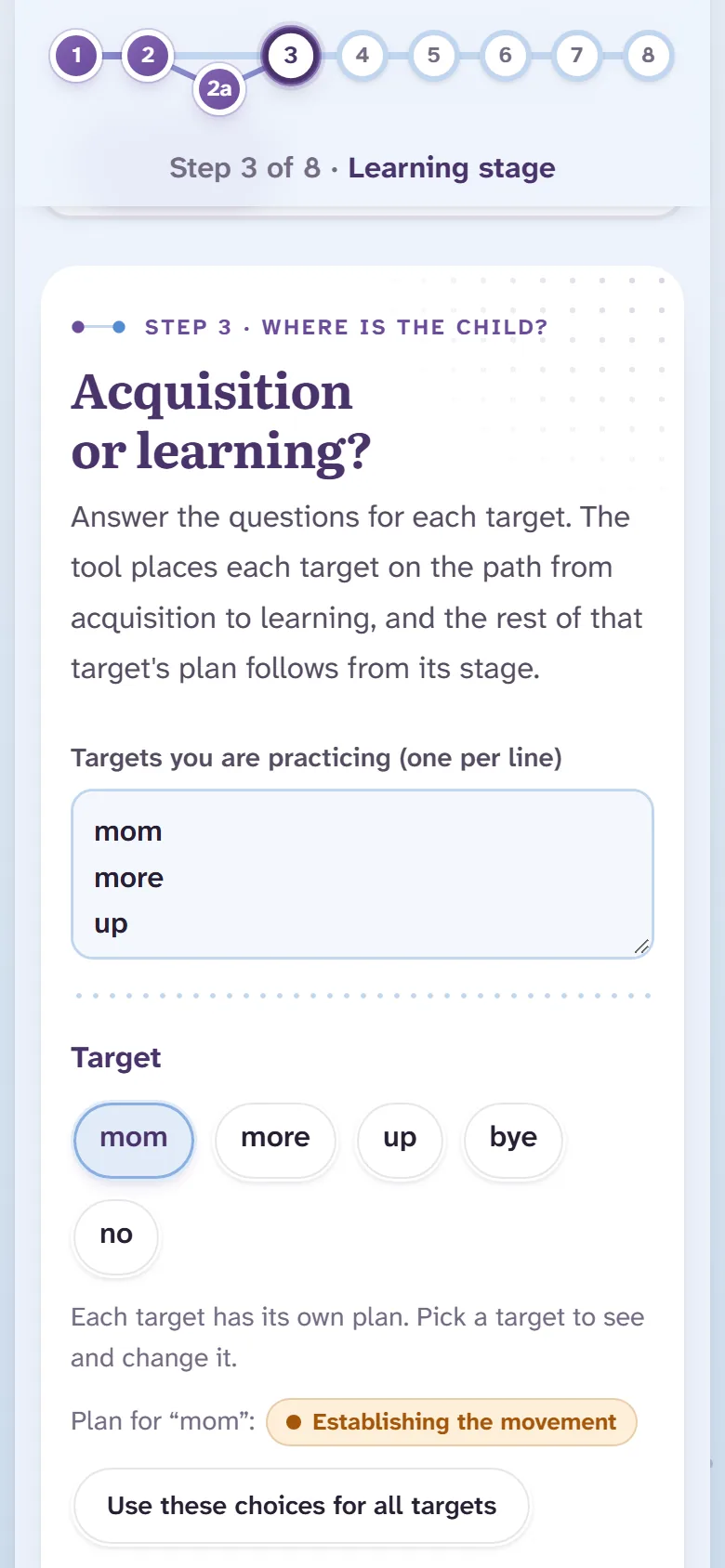
Each step asks a few questions and suggests what fits the child's learning stage. You can change any suggestion; the planner shows when a choice is ahead of or behind the stage.
Step 1
The child
Initials or a nickname, age, severity and the targets you're practicing.
Step 2
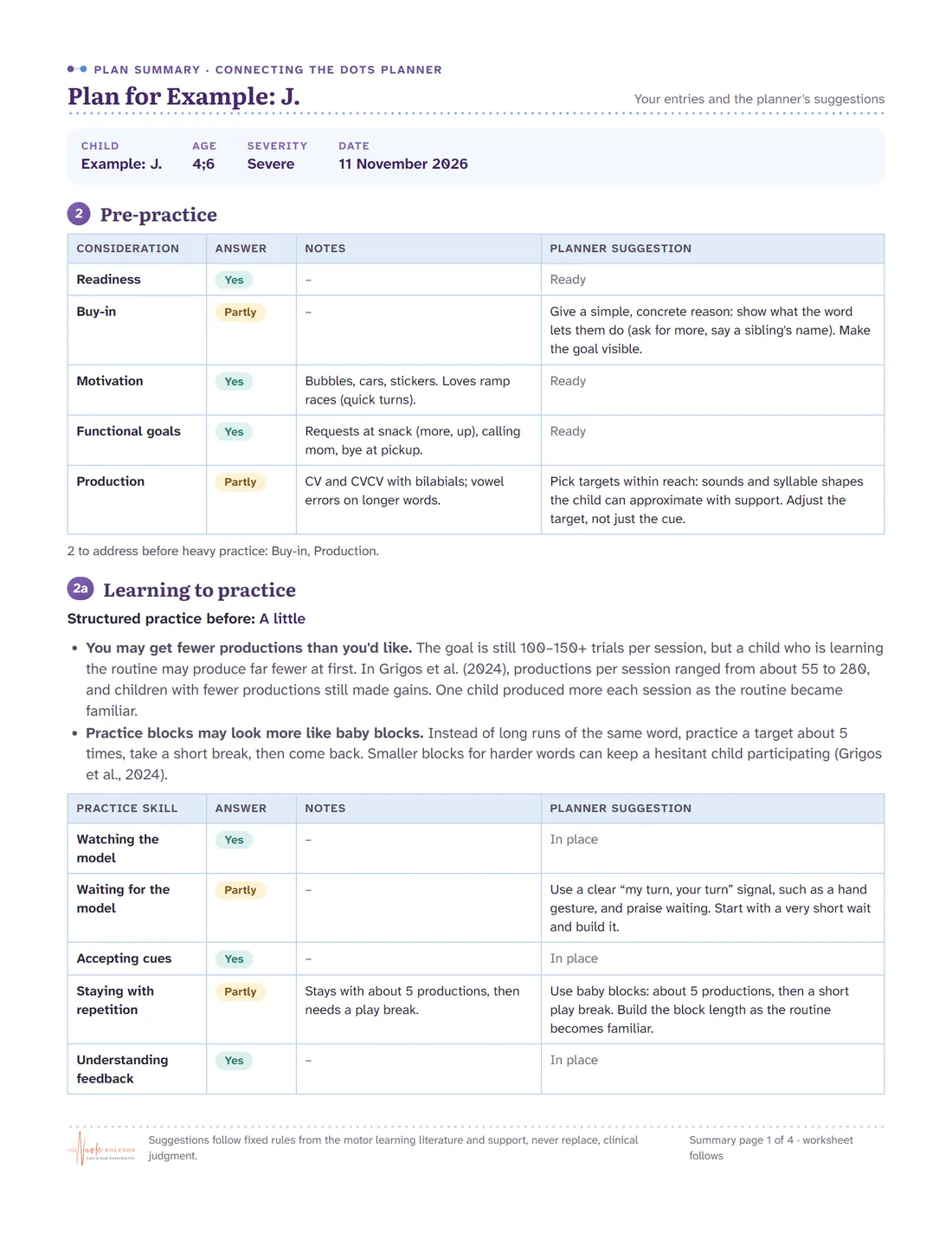
Pre-practice
- Readiness
- Buy-inPartly
- Motivation
- Functional goals
- ProductionPartly
Readiness, buy-in, motivation, functional goals and production, before practice starts.
Step 2a · If needed
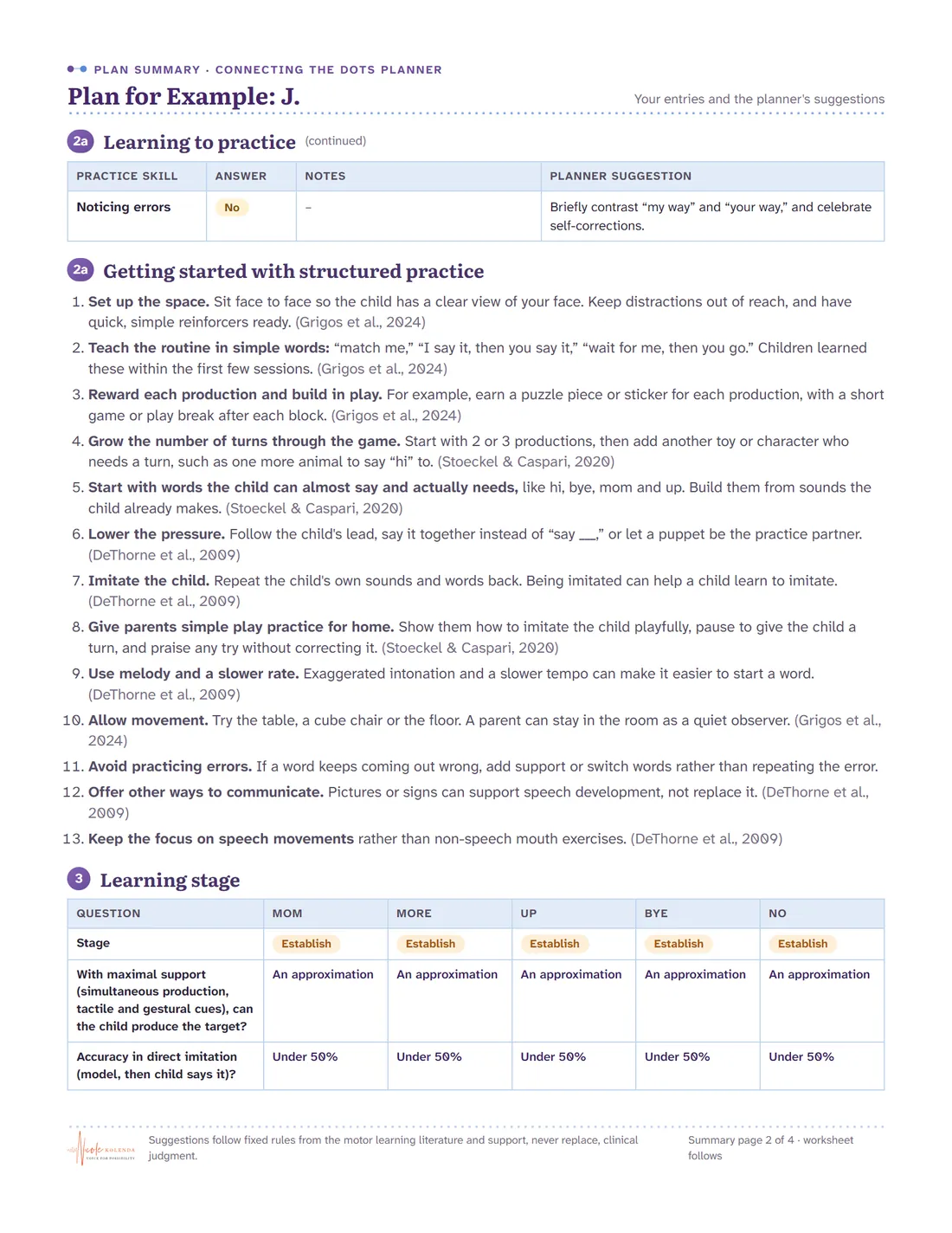
Learning to practice
“Stays with about 5 productions, then needs a play break.”
For a child who is new to structured practice: watching, waiting, staying with repetition.
Step 3
Learning stage
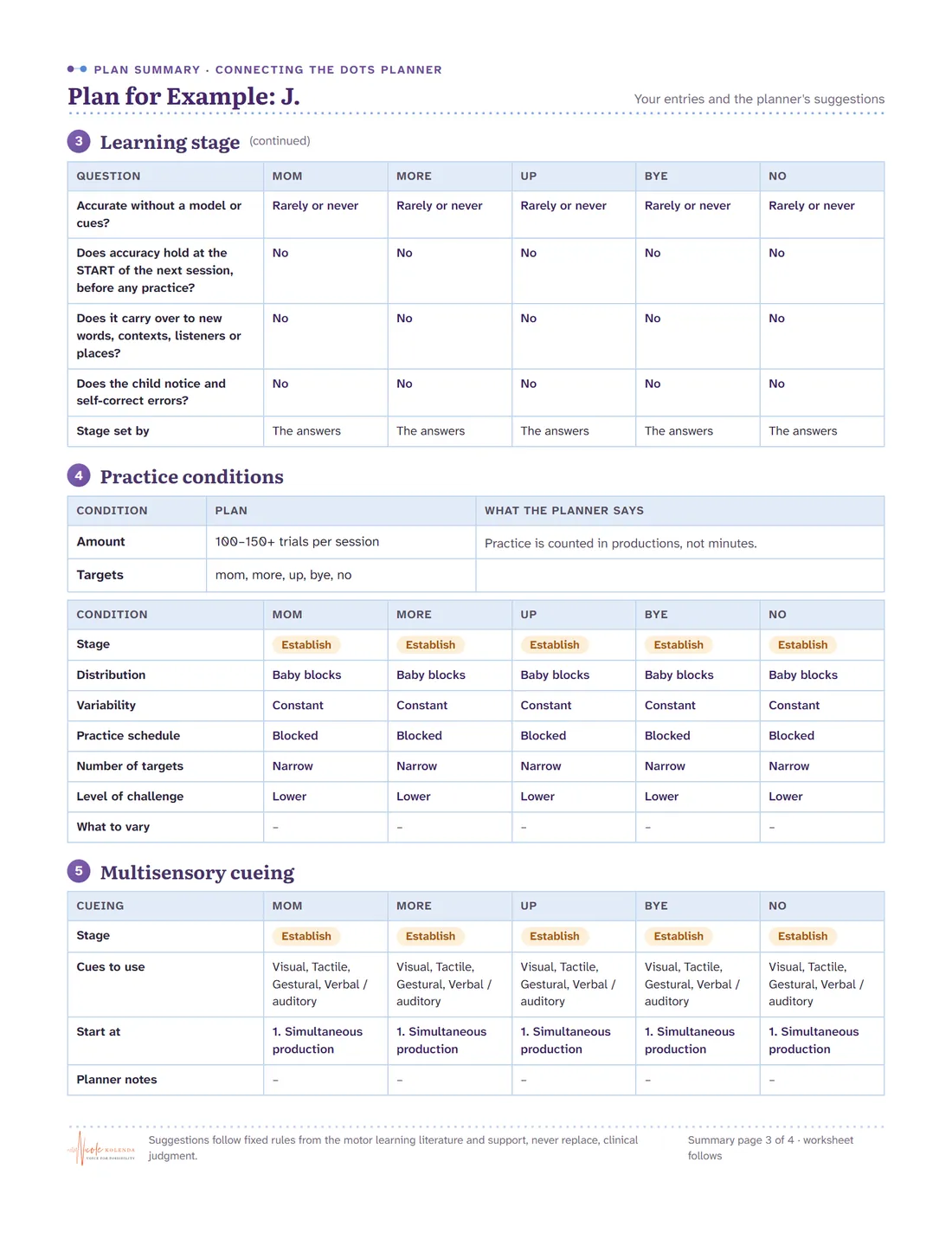
Establishing, stabilizing or driving learning, decided target by target.
Step 4
Practice
Baby blocksMassedDistributed
ConstantVary one thingVariable
BlockedSmall blocksRandom
Amount, spacing (including baby blocks), variability and the order of targets.
Step 5
Cueing
- 4Spontaneous production
- 3Delayed imitation
- 2Direct imitation
- 1Simultaneous productionStart here
Where to start on the cueing ladder, and when to fade.
Step 6
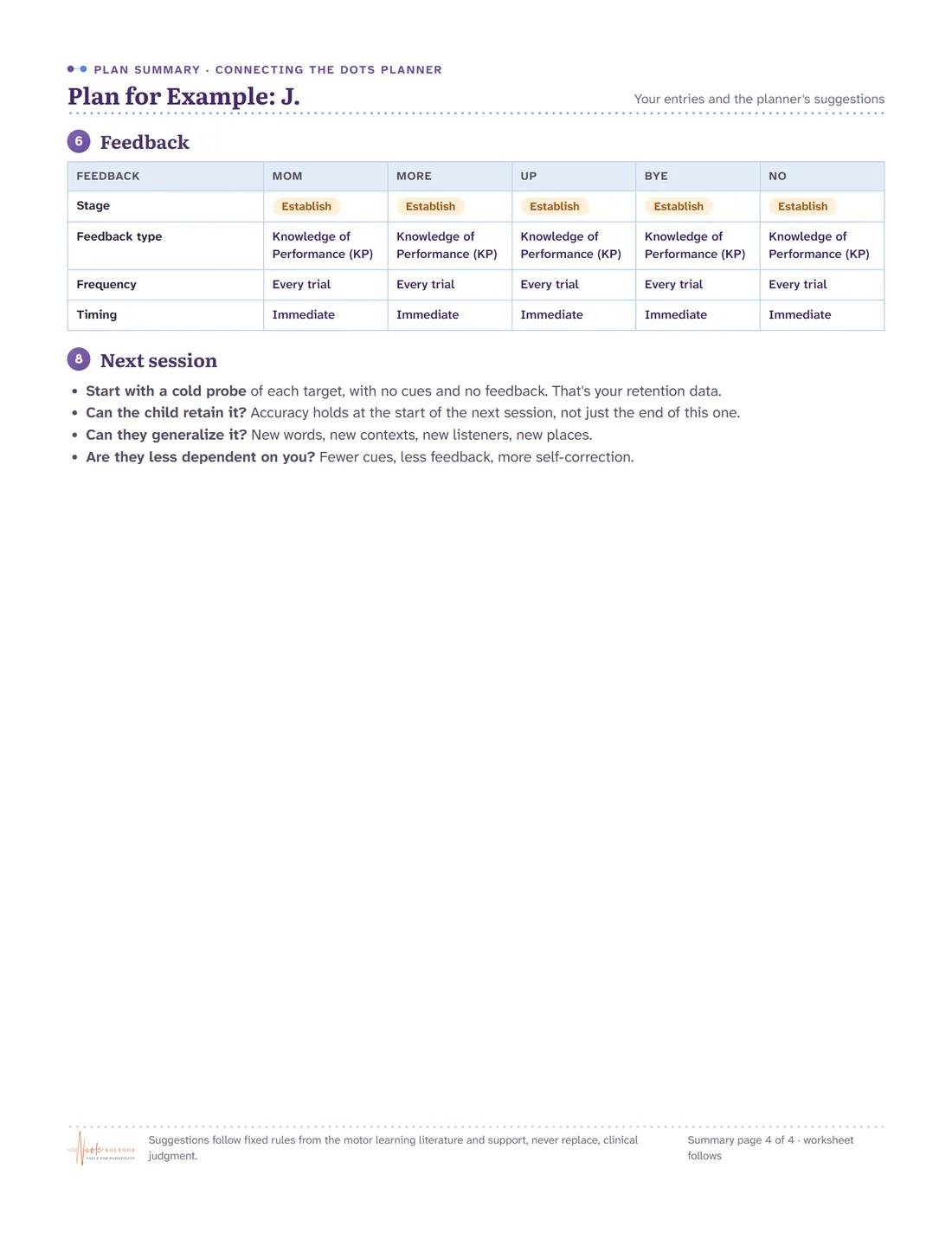
Feedback
“Your lips came together that time!”
Knowledge of performance or of results, how often, and when.
Step 7 · Pro
In session
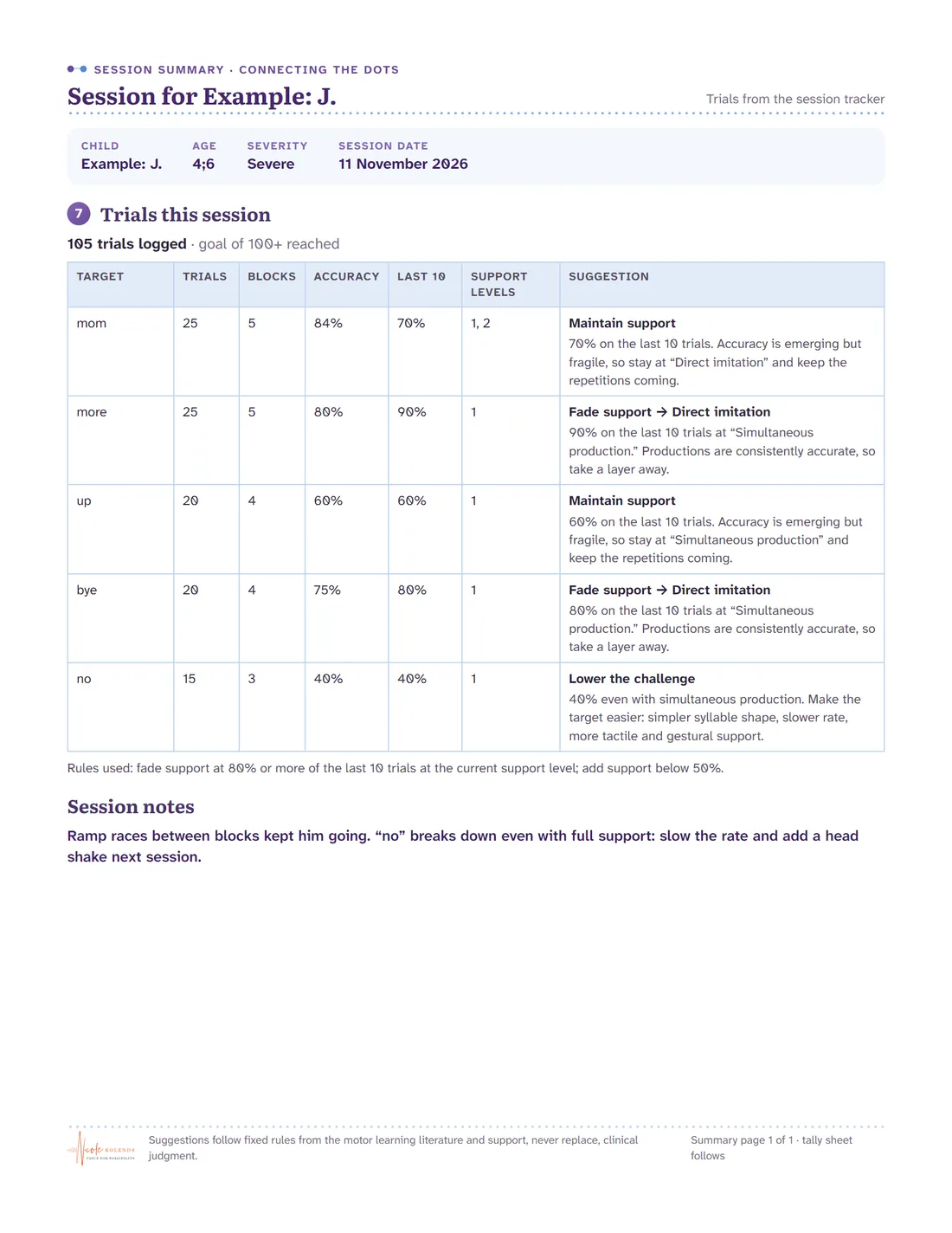
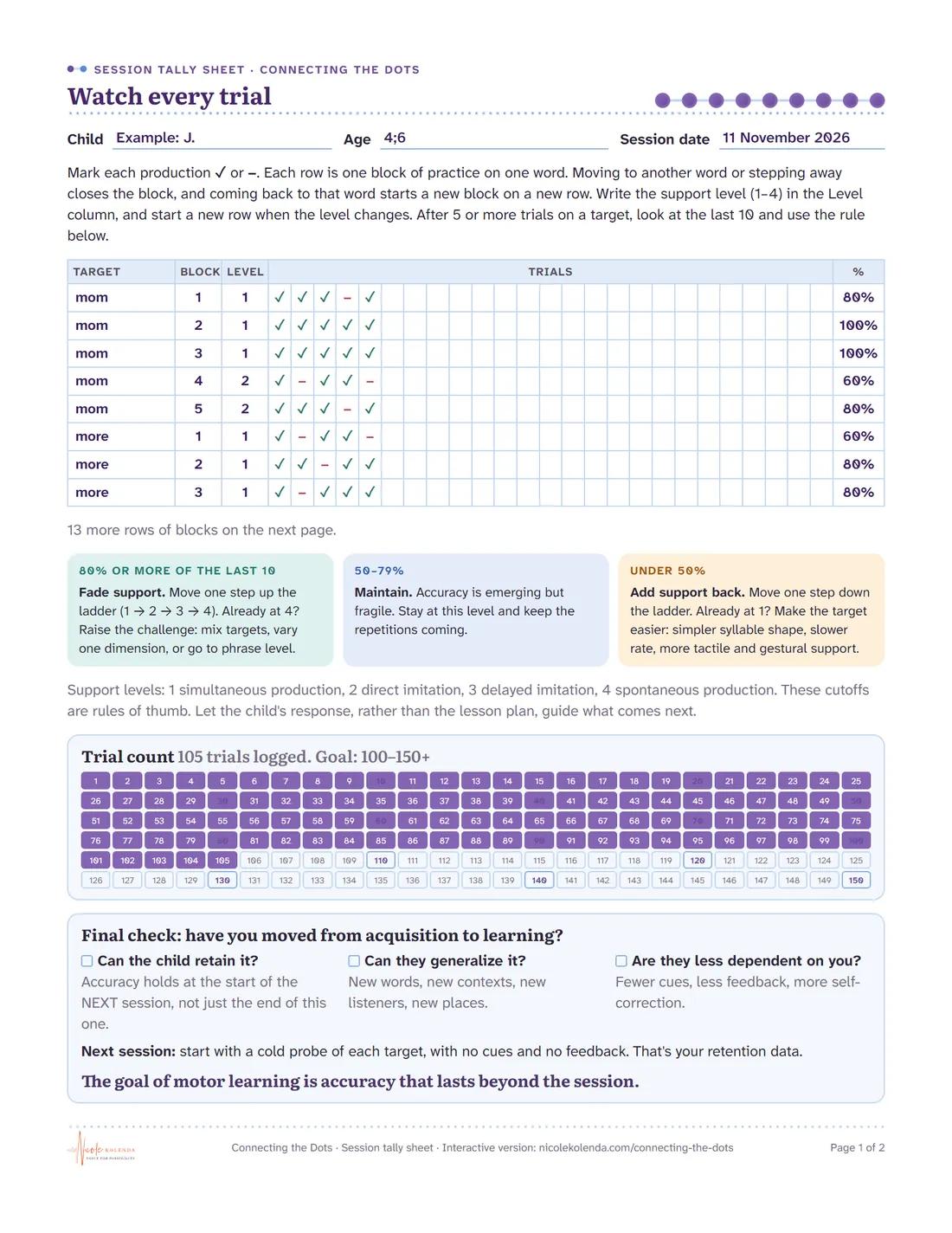
Track every trial and see when to fade, maintain or add support.
Step 8
The plan
The whole plan in one PDF, ready to print or save.
The PDF
A finished plan
This is the plan the planner makes for its own example, a made-up child called J., age 4;6. Your answers and the planner's suggestions for every step, then a worksheet to print. With Pro, the session tracker adds step 7: every trial on each word, and what to do next.
Free or Pro
What Pro adds
Pro is built for practices, supervisors and clinical fellows: client records with HIPAA protections, session tracking over time, and a shared place to plan together.
| Free planner | Pro | |
|---|---|---|
| 8-step planner, linked to principles | ||
| PDF of the plan and worksheet | ||
| Plans kept | This browser only | Secure cloud, any device |
| Children | One at a time | Your whole caseload |
| Session tracker | Preview only | |
| Saved sessions and plan versions | – | |
| Mentor and supervisor notes | – | |
| Team roles | – | |
| HIPAA: BAA, two-step sign-in, activity log | Not needed: nothing leaves your browser |
Connecting the Dots of Motor-Based Intervention: Principles of Motor Learning in Real-World Practice
An invited session at the 2026 ASHA Convention by Nicole Kolenda and Pooja Aggarwal. The planner walks through the same steps as the talk, so you can follow along on your phone.
Suggestions follow fixed rules drawn from the motor learning literature (Maas et al., 2008; Schmidt & Lee, 2019; Guadagnoli & Lee, 2004; Strand, 2020) and support, never replace, your clinical judgment.