Focus 1
Treatment research for CAS
Who responds to motor-based treatment like DTTC, how much practice helps, and how a child's speech movements change as they improve.

Research · New York University
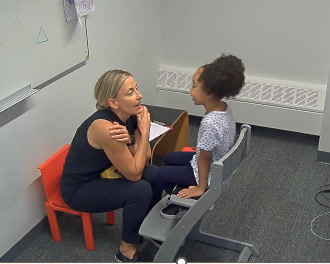
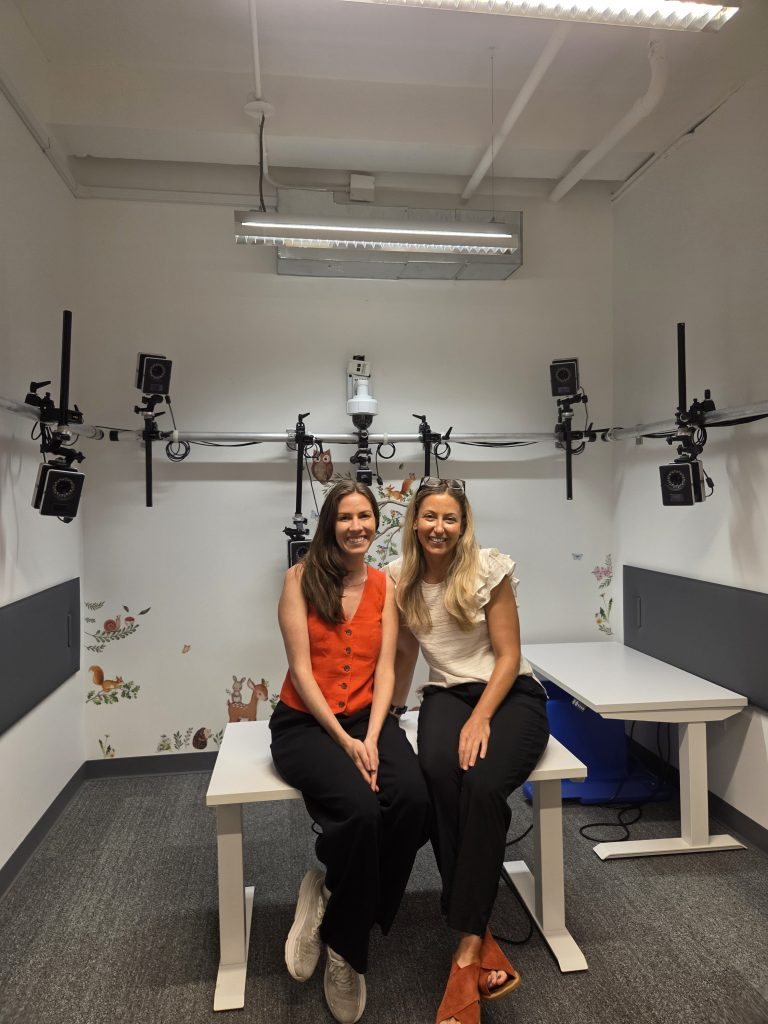
At New York University's Motor Speech Lab, led by Dr. Maria Grigos, research focuses on speech motor control and the relationship between speech motor control and sound production. The lab is investigating the efficacy of motor-based treatments for childhood apraxia of speech (CAS), and Nicole serves as the Lead SLP on this initiative.

Our mission
The lab studies speech motor control and motor learning to give clinicians and families evidence-based guidance for children with speech sound disorders, especially childhood apraxia of speech.
Focus 1
Who responds to motor-based treatment like DTTC, how much practice helps, and how a child's speech movements change as they improve.
Focus 2
How children and adults plan and coordinate the lips, jaw and tongue, and how rate, prosody and stuttering affect those movements.
How the lab measures speech
Nicole and NYU
Undergraduate degree in Communicative Sciences and Disorders at NYU.
Master's degree from Teachers College, Columbia University, where she learned from Dr. Maria Grigos, now Director of the NYU Motor Speech Lab.
Returned to NYU as a Clinical Supervisor and began collaborating with Dr. Grigos on research.
Began teaching in the graduate program. Her first class was Speech Sound Disorders.
Joined the Motor Speech Lab full time as the lead SLP on an NIH-funded treatment study for childhood apraxia of speech (CAS).
Received an NYU Steinhardt Graduate Student Organization (GSO) Star Award. These annual awards honor outstanding faculty in the NYU Steinhardt community.
The 5-Year Researcher Award, during her full-time tenure in the lab.
I love sharing what I have learned.
Nicole also runs the lab's Instagram, dedicated to pediatric motor speech disorders and to helping clinicians make the shift to motor-based therapy.
Watch Nicole's teaching videos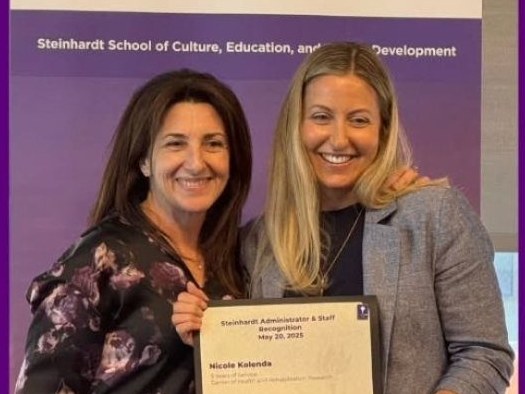
Current study · Now enrolling
DTTC-Connect is a new, structured version of Dynamic Temporal and Tactile Cueing for children with CAS who are ready to go beyond single words. The NYU Motor Speech Lab is testing it in a randomized trial with Hofstra University and the National Institute on Deafness and Other Communication Disorders (NIDCD).
The practice steps
Starting with two-word phrases, support fades as the child takes over.
Published research
 ASHA Journals2025Nicole is a co-authorA framework for measuring treatment fidelity in motor-based speech intervention for children with CASGrigos, M. I., Tampakis, P., Wang, E., Kolenda, N., Strand, E., Wambaugh, J., Lu, Y., Lyu, Z., & Case, J.American Journal of Speech-Language Pathology, 34(5), 2827–2845.Read the paper ASHA Journals2025The pathway to research-reliable DTTC for children with CAS: A multiphase process for training community-based cliniciansCase, J., Grigos, M. I., Velleman, S., Thomas, D., Murray, E., Anumandla, S., & Iuzzini-Seigel, J.American Journal of Speech-Language Pathology, 34(4S), 2359–2382.Read the paper ASHA Journals2025Training on childhood apraxia of speech: Experiences of speech language pathologistsKeller, S., Valentine, H., Harel, D., & Grigos, M. I.American Journal of Speech-Language Pathology, 34(4S), 2464–2484.Read the paper ASHA Journals2024Dynamic Temporal and Tactile Cueing (DTTC) in young children with childhood apraxia of speech: A multiple single-case designGrigos, M. I., Case, J., Lu, Y., & Lyu, Z.Journal of Speech, Language, and Hearing Research, 67(4), 1042–1071.Read the paper ASHA Journals2024Dynamic Temporal and Tactile Cueing: Quantifying speech motor changes and individual factors that contribute to treatment gains in childhood apraxia of speechGrigos, M. I., Case, J., Lu, Y., & Lyu, Z.Journal of Speech, Language, and Hearing Research.Read the paper ASHA Journals2024Research priorities for childhood apraxia of speech: A long viewMcCabe, P., Beiting, M., Hitchcock, E. R., Maas, E., Meredith, A., Morgan, A. T., Potter, N. L., Preston, J. L., Moorer, L., … & Grigos, M.Journal of Speech, Language, and Hearing Research.Read the paper
  BMC · Springer Nature2023Dose frequency randomized controlled trial for Dynamic Temporal and Tactile Cueing (DTTC) treatment for childhood apraxia of speech: Protocol paperIuzzini-Seigel, J., Case, J., Grigos, M. I., Velleman, S., Thomas, D., & Murray, E.BMC Pediatrics, 23(1), 1–14.Read the paper ASHA Journals2023Naïve listener perceptions of speech intelligibility in children with apraxia of speechWang, E. W., & Grigos, M. I.Journal of Speech, Language, and Hearing Research.Read the paper ASHA Journals2025How does prosodic prominence impact articulatory movement parameters and movement variability in adults who stutter?Kopera, H., & Grigos, M. I.Journal of Speech, Language, and Hearing Research, 68(7S), 3602–3626.Read the paper
  SAGE2024Effects of speaking rate changes on speech motor variability in adultsWang, E. W., & Grigos, M. I.Language and Speech.Read the paper ASHA Journals2023The Multilevel word Accuracy Composite Scale (MACS): A novel measure of speech production in childhood apraxia of speechCase, J., Wang, E. W., & Grigos, M. I.American Journal of Speech-Language Pathology.Read the paper ASHA Journals2022Listener ratings of speech accuracy in children with speech sound disordersJing, L., & Grigos, M. I.American Journal of Speech-Language Pathology.Read the paper ASHA Journals2022Graduate student clinicians' perceptions of child speech sound errorsJung, L., Ling, L., & Grigos, M. I.Perspectives of the ASHA Special Interest Groups, 7(4), 1275–1283.Read the paper SAGE2021Production of English lexical stress by Mandarin speakers: Acoustics and kinematicsLi, J., & Grigos, M. I.Second Language Research, 39(3), 667–695.Read the paper ASHA Journals2021The effect of practice on variability in CAS: A multidimensional analysisCase, J., & Grigos, M. I.American Journal of Speech-Language Pathology, 30(3), 1477–1495.Read the paper ASHA Journals2020A framework of motoric complexity: An investigation in children with typical and impaired speech developmentCase, J., & Grigos, M. I.Journal of Speech, Language, and Hearing Research, 63(10), 3326–3348.Read the paper
  Wolters Kluwer2020Communication efficiency in a face transplant recipient: Determinants and therapeutic implicationsLevy-Lambert, D., Grigos, M. I., LeBlanc, E., Alfonso, A., Ramly, E., Kantar, R., & Rodriguez, E.Journal of Craniofacial Surgery, 31(6), 528–530.Read the paper ASHA Journals2020How the study of speech motor control informs intervention in CASCase, J., & Grigos, M. I.Perspectives of the ASHA Special Interest Groups.Read the paper
  Elsevier2020Total eyelid transplantation in a face transplant: Analysis of postoperative periorbital functionGrigos, M. I., LeBlanc, É., Rifkin, W. J., Kantar, R. S., Greenfield, J., Diaz-Siso, J. R., & Rodriguez, E. D.Journal of Surgical Research, 245, 420–425.Read the paper
  Taylor & Francis2019Lexical stress in childhood apraxia of speech: Acoustic and kinematic findingsKopera, H., & Grigos, M. I.International Journal of Speech-Language Pathology.Read the paper ASHA Journals2019Changes in articulatory control pre and post facial transplant: A case reportGrigos, M. I., LeBlanc, E., Hagedorn, C., Diaz-Siso, J. R., Plante, N., & Rodriguez, E. D.Journal of Speech, Language, and Hearing Research, 62, 297–306.Read the paper ASHA Journals2018Investigating the use of a nonspeech task to measure tongue–jaw differentiation: Findings across typical developmentSmall, H., McAllister, T., & Grigos, M. I.American Journal of Speech-Language Pathology, 27(3), 1030–1038.Read the paper Taylor & Francis2018Changes in movement transitions across a practice period in childhood apraxia of speechGrigos, M. I., & Case, J.Clinical Linguistics & Phonetics, 32(7), 661–687.Read the paper ASHA Journals2016Articulatory control in childhood apraxia of speech in a novel word-learning taskCase, J., & Grigos, M. I.Journal of Speech, Language, and Hearing Research, 59, 1253–1268.Read the paper ASHA Journals2016Speech sound disorders: What's motor got to do with it?Grigos, M. I.Perspectives of the ASHA Special Interest Groups, 1(1), 75–87.Read the paper
  Hindawi · Wiley2015Nonword repetition and speech motor control in childrenReuterskiöld, C., & Grigos, M. I.BioMed Research International, 2015, 683279.Read the paper ASHA Journals2015Oral articulator movement in childhood apraxia of speechGrigos, M. I., Moss, A., & Lu, Y.Journal of Speech, Language, and Hearing Research, 58, 1103–1118.Read the paper
 On Substack
Clinical reasoning in pediatric motor speech: a space to explore the thinking behind therapy.
Free essays on the thinking behind therapy. Read the latest