
Treatment for CAS
What is DTTC?
Dynamic Temporal and Tactile Cueing is an evidence-based, motor-based treatment for children with moderate to severe childhood apraxia of speech. Dr. Edythe Strand developed it from integral stimulation, and it applies the principles of motor learning at every step.

- 1SimultaneousSay it together
- 2Direct imitationWatch, then say it
- 3Delayed imitationWait, then say it
- 4SpontaneousSay it on your own
The goal
Help the brain plan speech movements

DTTC aims to make the brain's processing more efficient so the child can build and refine motor planning and programming, especially the timing and size of each movement, and use strategies that carry new words into everyday speech.
It shifts attention away from single sounds and toward the movement across a whole word. Through repeated practice, DTTC:
- Clear modelsGives clear auditory and visual models.
- Shaped movementShapes movement with slowed rate, visual cues and touch.
- Cues that fadeAdds and fades cues as needed.
- Specific feedbackFeedback on the movement early (knowledge of performance), then on the result (knowledge of results).
How a session works
Up and down the cueing hierarchy
Watch the four levels in about 40 seconds: what the clinician says, when the child answers, and when it’s time to move on. Turn the sound on to hear both voices.
- SimultaneousMove on: 5–15 correct
- Direct imitationMove on: 5–15 correct
- Delayed imitationMove on: 10–15 correct
- SpontaneousMastery: 10 correct across 3 sessions
Remember
- Prosody is taught from the very start, not added later.
- Practice is positive: when a production is off, the clinician steps in right away.
- Clinicians stay aware of their own jaw, lips and tongue while modeling.
- DTTC isn't play-based, but it can be joyful.
Hear the hierarchy
What the DTTC hierarchy sounds like
For years, my best teaching tool has been real therapy video, shown at our conferences with parents' consent. Social media is different: once a video is posted, it can be shared and found long after therapy ends, and the child is too young to weigh in.
So for the hierarchy video, I played both parts. I recorded the clinician and the child myself, an AI voice tool turned my lines into a child's voice, and the animation shows the timing of each level. The technique comes through clearly, and no child had to be on camera to teach it.
Nicole

From the source
Working with Dr. Edythe Strand
Dr. Strand developed DTTC. She and Nicole are putting together classes on the DEMSS, and on the first day of Apraxia Awareness Month she joined Nicole on the lab's Instagram with advice for clinicians making the shift to motor-based treatment.
Watch Dr. Strand and NicoleSee it explained
DTTC videos with transcripts
 "Watch Me, Listen to Me, and Do What I Do"
 When a Child Can't Engage in Dynamic Assessment Yet
 Dynamic Assessment in Action: One DEMSS Item
 What Is Dynamic Assessment, and Why Does It Matter?
 Quick Tip: Targeting Prosody in DTTC
 Why We Vary Prosody in DTTC: Dirt Road or Six-Lane Highway?
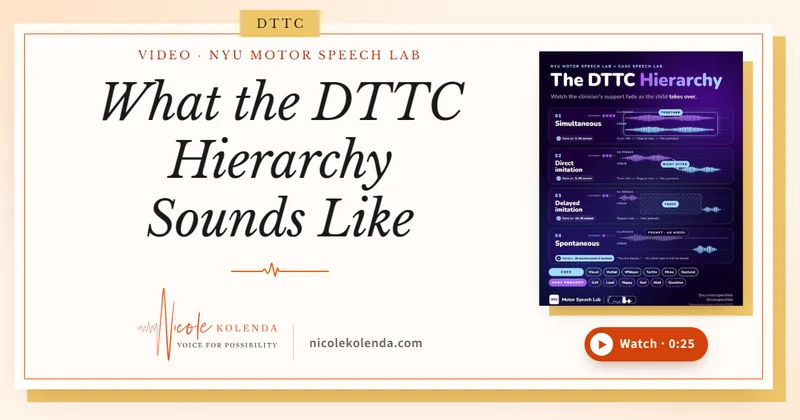 What the DTTC Hierarchy Sounds Like
 Backward Chaining in DTTC: Practicing "Funny"
Show all 41 DTTC videos
 Treating CAS and Other Speech-Language Goals in the Same Session
 DTTC Is Not Play-Based (But It Can Be Joyful)
 Conscious Practice and Blocked Practice in Pediatric Motor Speech Therapy
 Kicking Off Apraxia Awareness Month With Dr. Edythe Strand
 Choosing Phrase Targets for CAS, With Amy Graham
 Talking Through the STRIVE Framework With Amy Graham
 Don't Skip Varied Prosody
 Progress Is Not Linear: Moving Through the DTTC Hierarchy
 When a Target Word Is Too Hard
 Lab Updates: Apraxia Kids Walk, ASHA, and a Free Lunch and Learn
 Setting Up for Success: Build Rapport First
 When Direct Imitation Is Too Hard
 Simultaneous Production in the DTTC Hierarchy
 Now Recruiting: Two CAS Treatment Studies
 End Every Block on a Positive Note
 What Is Treatment Fidelity?
 Progress Is Not Linear
 The DTTC Hierarchy: Delayed Imitation and Spontaneous Production
 Our CAS Treatment Studies, With Dr. Julie Case
 What to Do Instead of Negative Practice
 Partnering With Older Kids in Motor Speech Therapy
 DTTC Tip: Start Every Block With Direct Imitation
 Key Elements of Practice, Part 4: Practice Prosody From the Start
 What I Say to New Participants to Set Up Treatment
 Target Word "Hi," Part 2: Moving Up the DTTC Hierarchy
 I Have My Target Word, but Where Do I Start?
 Video Record Yourself When You Start DTTC
 How Nicole Organizes Her DTTC Sessions
 Sprinkling In Spontaneous Productions
 End Every Block on an Accurate Production
 Picking Target Words From the DEMSS
 Simultaneous Production: The First Step in DTTC
 How to Include Your Child’s Sibling in Their Speech Therapy Progress
Learn more
Research
- Strand, E. A. (2020). Dynamic Temporal and Tactile Cueing: A treatment strategy for childhood apraxia of speech. AJSLP, 29(1), 30–48. Read
- Grigos, M. I., Case, J., Lu, Y., & Lyu, Z. (2024). DTTC in young children with CAS: A multiple single-case design. JSLHR, 67(4), 1042–1071. Read
- Grigos, M. I., … Kolenda, N., … & Case, J. (2025). A framework for measuring treatment fidelity in motor-based speech intervention for children with CAS. AJSLP, 34(5). Read
On Substack
The Thinking Clinician
Clinical reasoning in pediatric motor speech: a space to explore the thinking behind therapy.
Free essays on the thinking behind therapy. Read the latest