May 22, 2024 · 2:03 · DTTC
The DTTC Hierarchy: Delayed Imitation and Spontaneous Production
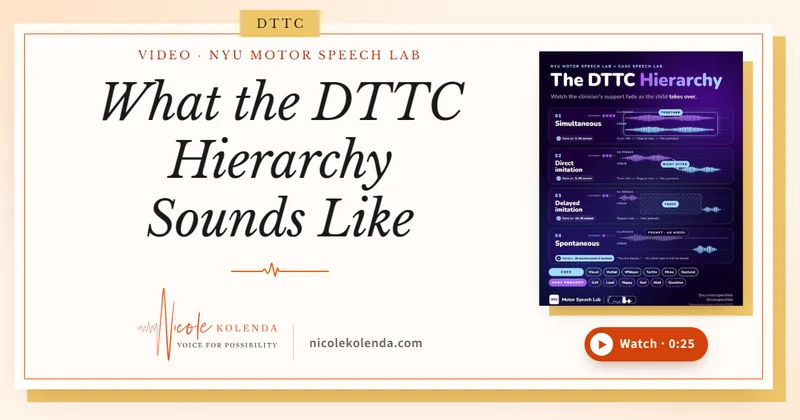
The four levels of the DTTC hierarchy, with how to explain delayed imitation to a child and how to plant “sprinkles” early for spontaneous production.

Full transcript
Hi, it's Nicole from the NYU Motor Speech Lab, coming in to answer a quick question from a clinician who reached out about the DTTC hierarchy.
We know there are four stages in the hierarchy. We have simultaneous production, which is saying the target together with the therapist. Next comes direct imitation, which is exactly how it sounds: I say the target, you say the target. At each level of the hierarchy, we're varying prosody.
But the last two levels can be a little tricky. The third level is what we call delayed imitation. Typically, when you're here, you have to explain to the child what you're doing, because they're now so used to imitating you, or to simultaneous production, that they'll just say the target. So what you have to do is say, "Okay, I'm going to say the word, and then we're going to count to three, and then I'm going to point to you, and you're going to say the word." Let's say the target word is "bye." You'll say, "Okay, I'm going to say the word: 'bye.' One, two, three." Then you point to the child and have them say the word. We're looking to build in that lag time between the model and their production.
The last level in the hierarchy is spontaneous production, which can get a little tricky. I like to refer to these as "sprinkles." What I like to do is set my future clinician self up for success. If I know I have a word I'm going to push into spontaneous, which hopefully is every word I'm working on, I start setting that up early. So if the target word is "bye," I'll ask, "What did we say to Mommy when we shut the door? What did we say to Daddy when we got off the elevator?" "Bye!" That way, when I want to sprinkle those into spontaneous, they know what the expectation is. So I'm doing this all along.