October 28, 2025 · 3:38 · DTTC
Progress Is Not Linear: Moving Through the DTTC Hierarchy
A child reached delayed imitation with varied prosody, then couldn't do the word in direct imitation one block later. Why that's normal in DTTC, how to step back down the hierarchy, and why clinicians need to stay present.

Full transcript
Hi, it's Nicole coming in from the NYU Motor Speech Lab. The question is: "Nicole, I was working on a block and the child was able to get to delayed imitation with varied prosody. After I cycled through a couple of other words and went back to that word, they couldn't even do it in direct imitation. What do I do?"
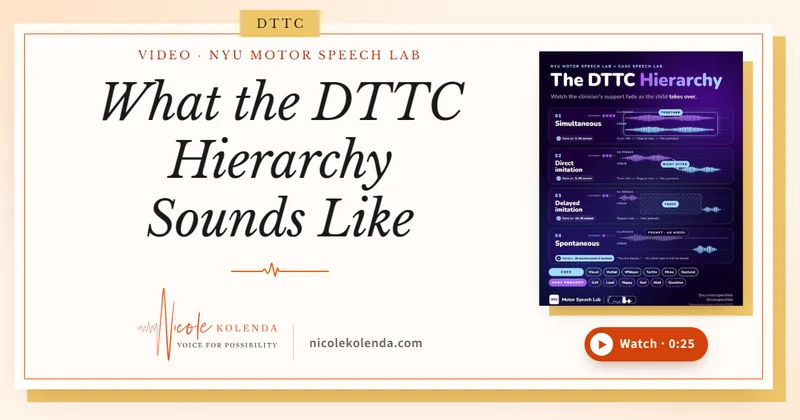
It's such a good question, and this happens all the time. We have to remember that progress in pediatric motor speech therapy is not linear. This is why it's a dynamic treatment, and why Dr. Strand specifically created the levels of the hierarchy with up and down arrows. You're going to be going back and forth between the levels of the hierarchy, especially if you just hit delayed imitation with varied prosody for the first time, which is super exciting.
When you come back and work on that word again in the next block, they might not be there. So what do you do? You start with direct imitation and test it out, and you'll see immediately, okay, they don't have it. You do not want to stay in direct imitation, because remember, we do not want to engage in negative practice, practicing the same target incorrectly over and over again.
So you'd say, "Okay, hold on. Let's say it together," and go back down to simultaneous production. You get it in simultaneous: "Let's say it together. Happy. Happy." Then you go back to direct imitation: "I'm going to say it, and then you say it. Happy."
When I know the kid has it, something I like to do is put my hand up and say, "Okay, say it five times in a row." I'm not giving them feedback directly until after. This is a sort of delayed feedback; I want them to try to get it on their own. So: "Happy, happy, happy." If they mess it up, I stop immediately and go back to direct imitation, and hopefully you get it. Then you can push back up to delayed imitation with varied prosody. You can see how this becomes a longer block, because you're working your way back to where you were.
What I also want to point out, and I've learned this the hard way after doing this treatment for the past five or six years and going back to look at my videos for our fidelity checks, is that we believe these kids are going to do well. We know they got it the last block. So we come into the block expecting them to be there, because we want it so badly for them. And sometimes, as a result, we miss errored productions. We can't help it; we're human.
So what I really want to encourage you to think about is staying present, in the moment, and really listening to how the child is producing the target. Because on the path to learning, they are going to move back and forth in that hierarchy until you can ultimately push them into spontaneous production.
I hope that's helpful.