July 14, 2025 · 2:00 · DTTC
When Direct Imitation Is Too Hard
What to do when a child loses a target in DTTC direct imitation: slow it down, whisper, mime, and if needed step back to simultaneous production, because the hierarchy is dynamic.

Full transcript
Hi, it's Nicole from the NYU Motor Speech Lab. I'm coming in to piggyback on a post we did last week about direct imitation.
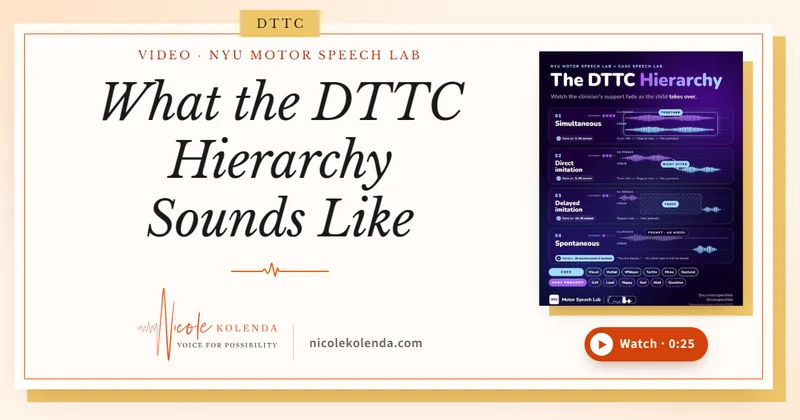
So you're in the DTTC hierarchy, working in direct imitation, and you realize in the moment that it's actually too hard. Let's say your target is "mom." You were able to go from simultaneous production, saying it together with lots of cues and feedback. They did it really well, say 10 times, you varied prosody, and you moved on. Now you're in direct imitation: you say the target, "mom," and the expectation is that they imitate it right after. Maybe you're working in a block and they get it, and then they don't.
So what do you do? Go back to the tools you learned for working with children with apraxia. You slow down the target, thinking about making it easier: "Okay, let's try it like this. Mom." And then have them say it. Still hard? Still having a hard time? Then you might say, "Okay, let's try it in a whisper." We do this because it lightens the load; you take the voicing off. Still hard? Maybe you just mime it: "Okay, just watch me, and move your mouth like mine." Notice that I'm giving a lot of feedback, gestures, and cueing.
If it's still too challenging in that moment, go back to simultaneous. It's not a big deal; that's the learning process. This hierarchy is dynamic. We're constantly moving up and down and back and forth. So you say, "Okay, you know what? Let's say it together. Mom." And then you work back up.