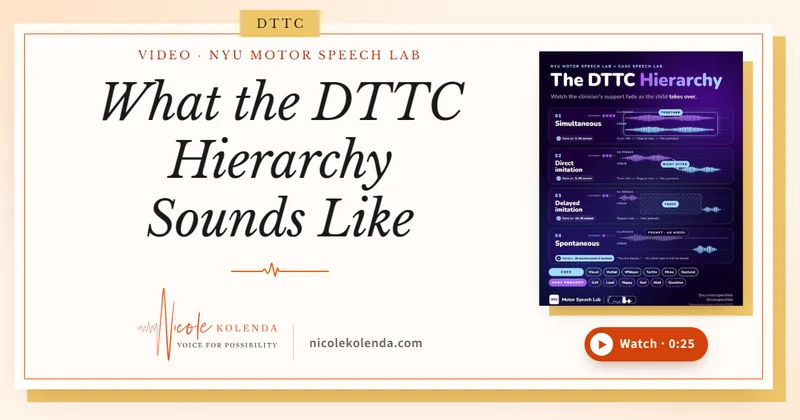
June 30, 2025 · 1:59 · DTTC
Simultaneous Production in the DTTC Hierarchy
Challenges at the simultaneous-production level of DTTC, and how to make a hard word easier: slow it down, just move your mouths together, then whisper, and set the word aside if needed.

Full transcript
Hi, it's Nicole from the NYU Motor Speech Lab. In our Instagram posts, we're talking about the levels of the DTTC hierarchy and some of the challenges at each level.
First, simultaneous production, where the child says the target with you. Most likely, you'll be starting at this level, because you picked these words because they're hard. Let's say the target word is "mom," and this child can't do "mom" in direct imitation. So you say, "Okay, we're going to say it together." Especially if it's their first time doing this type of therapy, I always like to say, "It's a little weird, it feels a little funny, I know. Just say it with me. It's okay, we've got this." You just acknowledge that it's a little strange to say the word together.
You have them focus on looking at your mouth, and you say, "Okay, we're going to say 'mom,'" and you do slow simultaneous production. You slow it down: "Mom." If you think about it, slowing down the target is really just elongating the vowel.
But what happens when slow simultaneous is still hard? You take it back and make it even easier by taking off some of the load. You say, "You know what? You're working so hard. I love how you're looking at me and how focused you are. We're not even going to say this word. We're just going to move our mouths." If they get the movement, you bring it back with a whisper, and then you circle back to adding voice: "Mom. Mom."
And if it's not feeling good, and you don't feel you can add voicing back in, put this word aside. That's okay. Let that word go. Because one of the key things we talk about all the time is that you don't want to engage in negative practice, saying the same target incorrectly over and over and over again.