May 4, 2023 · 15:37 · DTTC · Assessment
Target Word "Hi," Part 2: Moving Up the DTTC Hierarchy
Twelve sessions into a research study, Nicole traces one target word, "hi," session by session from a slow simultaneous whisper to spontaneous use, then answers a viewer question about scoring vowel and articulatory accuracy on the DEMSS.

Full transcript
Hi, it's Nicole from the NYU Motor Speech Lab, coming in during Apraxia Awareness Month. I wanted to do a part two on that target word, "hi," that I told you about, I think about two weeks ago.
When I first came on to tell you about the word "hi," it was the very beginning of treatment, and I was talking about what we do after we pick our target word. If you remember, this little boy was saying "duh" for everything. With "hi," I started out with slow simultaneous production, and he was still doing "duh." Then I took the voicing off, so we just did a whisper, and then it became right, and I had him doing it with me.
I wanted to walk through what the progression could look like when you work in blocks with kids who have motor speech disorders. Today was session 12. For the research study, we're doing 32 sessions: a total of eight weeks, four times a week, 45 minutes per session. So I took some notes.
Sessions 1 to 3: a slow simultaneous whisper, then voicing
For the first two sessions, we were in slow simultaneous production, in a whisper: "hi." By session three, I was able to add voicing back in, and by the end of that session we were able to get to a regular rate. We weren't slow anymore, and we had voicing: "hi," together. Which was awesome.
Session 4: direct imitation
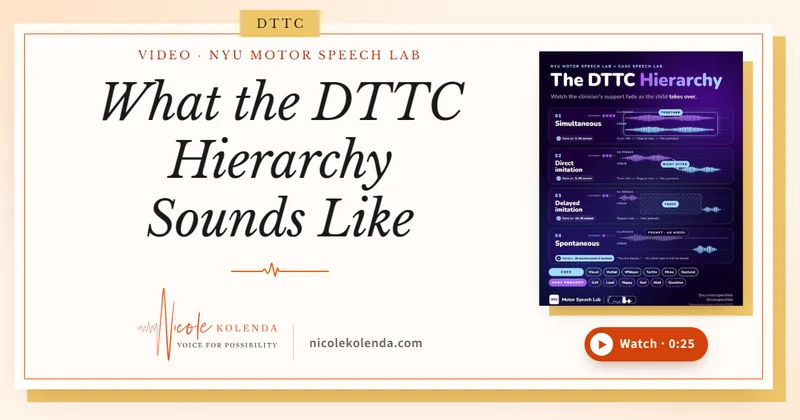
By session four, he was really starting to make gains, and I was able to go to direct imitation. If you think about the DTTC hierarchy, you start with simultaneous production, and you want to make sure you're working in blocks, so you're getting multiple productions of the target word. In simultaneous, they're doing it with you. Before you move on to direct imitation, you want to be able to vary prosody. So we sat in simultaneous, and when we varied prosody, what do I say? "Let's say it happy: 'hi.' Let's say it angry: 'hi.' Let's say it loud: 'hi.' Let's say it quiet: 'hi.'" I always do, "Can we say it as a question? 'Hi?'" And I start to cue them like this, so they know I want them to say it as a question, with that rising intonation.
Then we get to direct imitation, which is really exciting to get to by session four. Direct imitation: I say the word, you say the word. I've talked a little bit about this because it can get tricky. I always hold my hands up to give a cue for how many productions I want. And a lot of times, since you've been doing simultaneous, you have to reorient them to saying it after you. That sounds funny, because simultaneous feels weird in the beginning, but they get used to having the support, being able to look at you, and having you help shape their movements. So now I say, "Okay, hold on, we're going to do something different. I'm going to say the word, and then you're going to say the word: 'hi.'" And then they say "hi." I click down my fingers, or sometimes I have them click my fingers. I'm aiming for 10 to 15 productions.
I give them the feedback: "Do you feel how you're moving? Do you feel how you start with your mouth open like this, 'hi,' and then you get it big and then bring it back? 'Hi.' Do you feel that?" I really give them that feedback so they think intrinsically. This is making the shift; we talk about this a lot in the lab. I'm not saying, "Wonderful H sound," or "Oh, that's a great vowel." What I'm focusing on when I deliver my feedback is motor movement, mouth movement, and I want them to think intrinsically about how it feels.
A lot of what I had to do with this little boy in the beginning was that initial articulatory configuration, because he was doing "duh" the whole time. I spoke a little bit about this in the other video: I had to get him to come here, and I would say, "Meet me here," and just hold that initial configuration, because it was so challenging for him just to even get there.
So, session four: we're in direct imitation, I'm giving him this really great feedback, and I'm also able to vary prosody in direct imitation. At every step of the DTTC hierarchy, you vary prosody before you move on to the next step. So I say, "Okay, say it like me: 'hi,' 'hi,' 'hi,'" and we vary that prosody. And he was doing it, and he was doing it well.
"Can you fix it?"
Sometimes, if he didn't quite get it, I would say to him, "Can you fix it?" I've talked a little bit about this before too. This is one of my favorite things to do; Dr. Strand herself actually taught me this. You're implying that they know how to do it, while also telling them that they didn't say it right, and it just feels better. So if he didn't get it right, I would say, "Can you fix it?" before I gave him a cue.
What would that look like? Direct imitation: "hi." He says "hi." I say, "Say it again: 'hi,'" and he says something like "hi-sh," right? And I'll just say, "Can you fix it?" If he can say "hi," great, we keep it moving: "I love the way you moved your mouth. Did you feel that? You fixed it." If he can't fix it, I go, "Okay, I'm going to give you that model again: 'hi.' Now you try."
Moving back down the hierarchy
You might have a situation where you thought you were in direct imitation and they're not getting it. This is the dynamic part of this treatment. I hope I'm making sense. I'm sitting here, I think we're in direct, and all of a sudden his "hi" is off. I tell him to fix it, and it's still off. I give him the cue, and it's still off. What do I do? I go back to simultaneous. This is you working up and down the hierarchy. So I say, "Hold on," because I don't want him to keep getting it wrong; we don't want to engage in negative practice. I say, "Let's say it with me." I like to think of this as rejiggering, getting them back to where they were before, because I know they can do it. I get them to simultaneous, "Say it with me," and then I try to go right back to direct.
Sessions 5 and 6: delayed feedback, then delayed imitation
So by session four, we're at direct imitation with varied prosody. And by session five, which isn't this exciting, we're at delayed feedback. What does that mean? When I was initially doing direct imitation, I was giving him cues constantly. He knows he's getting it right: I'm clicking off my hands, I'm telling him he's moving his mouth wonderfully, I'm telling him to think about how he's moving his mouth and what it feels like to say this word. When we're in delayed feedback, I have him go through and do the productions, and I'm not saying anything. Can he get this word without me giving him all this feedback? I'm with him, I'm intently watching him, but I'm not giving that one-to-one feedback. So by session five, I was able to give some delayed feedback. When I saw or heard that it wasn't quite right, I would go back to my old favorite, "Fix it," and he was able to fix it.
By session six, we hit the delayed level, delayed imitation. What does that mean? Now I say, "Okay, we're going to do something a little different. I'm going to say the word, and we're going to wait, and I'm going to tell you when to say it." I don't want him to say it directly after me; I want there to be a bit of a delay. That gets a little tricky too, because now they're so used to saying the word right after you, so you have to teach this moment. What I usually do is say something like, "Okay, I'm going to say it first: 'hi.'" Then I count, and then I point to them and have them say it, so they get the hang of it. So we were in delayed imitation by session six.
Session 7 and beyond: spontaneous production and "sprinkling"
By session seven, I started pushing it into spontaneous production. What that means is, after I got varied prosody at the delayed level, I would say, "What did you say to me when you saw me at the elevator?" I don't want to give him that verbal model; I want him to be able to say it on his own. "What are you going to say to Mommy when you go home?" And I would have him start saying "hi." In the NYU Motor Speech Lab, we affectionately refer to this as sprinkling. So by session seven, I'm not in the block anymore. I'm sprinkling this word in as I work on blocks with other targets in my sessions.
Hi there. Sure, if you have a question, just put it in the chat. I'm almost done.
Anyway, I just felt like it's fun to think about how quickly we can get these words when we really focus on a motor perspective and work in block training. So by session seven, I'm sprinkling these words in, and I'm aiming for 10 in the session. I'm trying to get as many in there as I can, checking off every time I get it, and listening to how he sounds. What we're looking for is three sessions where I've sprinkled in the target word. "What are you going to say to Grandpa when you see him after speech with Nicole?" I sprinkle it in. If I can get three days in a row with 10 sprinkles where he sounds great, we're golden.
So when was that? That was session 10. We have a couple of other target words with him, but by treatment session 10, I would say we hit this goal. And today was session 12. What am I doing now? Every once in a while, I just check it. We were playing with Paw Patrol characters, and I would have him say, "Hi, Chase." Or, we have a video camera, and he knows that Daddy is watching, so I'd say, "Look at the camera and say hi to Daddy." And now we're starting to get "Hi, Daddy" or "Hi, Poppy," which is just incredible, because two weeks ago he was saying "duh" for everything. So by session 10, I had this word done.
A viewer question: scoring the DEMSS
"Can you explain the articulatory accuracy column of the DEMSS protocol?"
I'm answering off the cuff here. On the DEMSS, you have your vowel accuracy and you have your articulatory accuracy. If it's a two-syllable word, you also have prosody: are they hitting the prosody accurately?
For everybody watching, the DEMSS is the Dynamic Evaluation of Motor Speech Skill. It was developed by Dr. Edythe Strand, and it's the only dynamic assessment on the market right now. If you have a child with suspected CAS, it gives you a number score. What does it mean by dynamic? Built into the assessment, the child says the target word twice, no matter what. The first word on the DEMSS is "me." If they say "me," you have them say it again, "me," and you keep it moving. If they don't say the word correctly, what you're supposed to do on the DEMSS is cue for the word. Let's say I say, "Hey, say 'me,'" and they say "bee." I say, "Say 'me,'" and they say "bah." I'll say, "Okay, I want you to look at me. Bring your lips together: 'me.'" I'm slowing it down, and I'm really having them pay attention to my mouth. I'm allowed to go up to six back-and-forths, which is almost like mini-therapy. And then you give one more pass: I would say "me" and have them say it again.
For vowel accuracy, you'd be looking at whether the vowel was accurate. If the child said "bah" in this instance, it wasn't accurate. If the vowel is accurate, you give it a two. If you're unsure, you give it a one; sometimes, with the diphthongs, or with a kid who's really impacted, you might not be sure how to score that vowel, so you put a one. There are times, though, when you know they absolutely don't have it, like the word "toy" when they say "tah." That's not that vowel, so that would be a zero.
Then, moving on to articulatory accuracy: if the target word is "toy" and the child says "dah," that wouldn't be right either, so you wouldn't give them credit for that. And really, what you're doing at this point is cueing, and you're going to score articulatory accuracy after your cued attempt. You go through the back-and-forth and see if they can get it. Let's say they start with "dah," and you're able to get "toy" after you've cued them. You wouldn't put anything in that first column, because what you're going to do is work through your productions and then put it in the column for after your cueing, after your cued attempt. Am I making sense? And if they got it right, so let's say "me," "me," and they got it right, it would be two for the vowel, four for articulatory accuracy, and then one for consistency.
Yeah, it can be a little bit confusing. I think once you do it a couple of times, you can get it. I'm so happy to be able to answer that question, and to share with everybody what block training could look like. I'm really excited with how far this kid has come, and I'll keep giving updates. I hope everybody is doing well. If anyone has any questions or anything else, it's [email protected]. And Dr. Julie Case and I are going to come on and do a talk about how to elicit vowels, I think. I'm going to try to get her on the live next week. So stay tuned, and everybody have a great week. Take care.