February 2, 2026 · 34:26 · Target selection · Cueing · DTTC
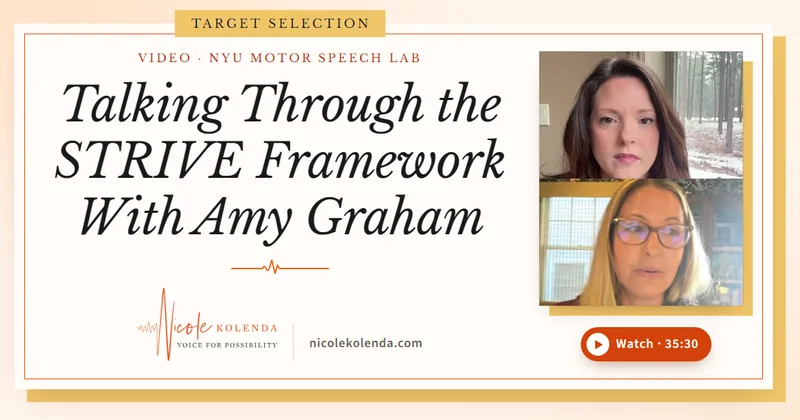
Choosing Phrase Targets for CAS, With Amy Graham
Back on Amy Graham's Instagram Live, Nicole talks about children with CAS who are ready for longer targets: what they look like in assessment, choosing meaningful phrases, cueing stress, and building rapport.

Full transcript
Amy: Hey, everybody. We're waiting for Nicole Kolenda from the NYU Motor Speech Lab to join us. We're going to talk about target selection. We talked a lot about target selection for childhood apraxia of speech, gosh, I think a couple of weeks ago, maybe. Today it's in terms of phrases. There she is. Hold on, let me make sure... okay, there we go. Hello! How are you?
Nicole: I'm doing well. A little frazzled. Today has been a day, I'm telling you. I'm just glad I'm back home in time to be here with you.
Amy: Yes, I am too. Well, thanks for doing this again. We got really good feedback. Has it been two or three weeks? I can't keep track of time. Somewhere around there, within the last month or so, we had you on to talk us through a framework for target selection: thinking about what we're going to target in therapy for our kids who have childhood apraxia of speech. We had fun, and we got good feedback, so I was like, let's do this again. I put a story out there with a question box, asking people what they'd want us to talk about if we did it again. And a few people mentioned: what about longer utterances? What about the kids where we're beyond single-word targets? Where do we go after that? So that's what we're going to talk about today.
CAS is a spectrum
Nicole: I'm actually really excited to talk about this, because when we think about apraxia and how it presents, it's a spectrum, and we know that. Those of us who are treating this population see it as a spectrum. We know there are kids who are more profoundly impacted and are really struggling at the single-word level. And then we have these other kids who just have more skill at this time, and they're speaking more in phrases or more complex word structures. Obviously, in treating these kids who fall under the umbrella of a CAS diagnosis, how we pick our targets is going to look different for them, right?
Something we're excited about at the NYU Motor Speech Lab and at the Case Speech Lab is looking at phrases in therapy, and we're hoping to look at this more formally going forward. I'm just throwing that out there: this is something we've explored in our current research. We do have data to back it up, but we're looking to do it a bit more formally.
Amy: I love that. That's great.
Nicole: I guess, to step back a little: if you've been feeling like you have a kid with CAS who would really benefit from a more complex target, your feelings are accurate, and you're probably right. So we wanted to have a little conversation about that, because I almost feel like, and Amy, I could be wrong, the focus has really been on single words with these kids. Would you say?
Amy: Yeah, absolutely. Granted, that's where I'm at with a lot of my kids, at least initially. We're looking at syllable shapes, we're looking at complexity, we're looking at different vowels, things to target with our younger or more severe kids. But you're right. Speaking as a typical SLP who may not specialize in apraxia, I think the struggle is that it's hard to get away from that traditional articulation approach. Okay, we're working on a word, I get that. So now do we just practice words in sentences? Is that what we're really doing in order to get more complex? What would you say to that SLP?
Think of a phrase as a syllable sequence
Nicole: No. Really, what I want you to be thinking about is that it's not really two or three words; it's really a syllable sequence.
Amy: That's a great way to put it.
Nicole: Almost in the way we think about "banana" as a multisyllabic word: when we're using phrasal targets, we're really thinking about them as syllables, and just making it more complex. And it may be that you were working with a child who progressed in treatment, and you're shape-shifting with them, which is amazing. Or this child is new to your caseload, and you're doing your due diligence, trying to figure out where they are, because you want to meet them where they're at. So I think it all comes down to a really good assessment.
What these children look like in assessment
Nicole: If I can, for a second, talk about what a child who needs phrases is going to look like in assessment. You're probably going to hear or notice distorted vowels and trouble with some consonants. You're going to see that most likely on all of your assessment tasks; that's most likely why they're coming to you in the first place. So you're going to be doing your Goldman-Fristoe. At our lab we really love the DEMSS, the Dynamic Evaluation of Motor Speech Skill, developed by Dr. Edythe Strand. Side note: it really is the only dynamic assessment on the market, which means it allows you to have a back-and-forth with the child on the target, to see how they respond to multisensory cueing. Super helpful.
You're going to see increased errors with multisyllabic words and longer output, those phrases. They might sound okay at the single-word level. On the GFTA, they might even appear more phonologically based: you'll hear a lot of the phonological patterns you're familiar with, let's say gliding, vowelization, cluster reduction. But when you test further, let's say you do a TPOT, or on the CELF you do Formulated Sentences, or you do your connected speech sample, which you must do (do your due diligence and do all of this, to get all the information you can and choose the right approach), then you're really going to start to notice more errors.
Amy: Okay.
Nicole: And lastly, something we think about with these kids who have more output is grammatical morphemes. If we think about the CELF, maybe on the Word Structure subtest they're using those grammatical elements, the progressive -ing or the past -ed, and they have them. But when we hear them talk in phrases or little sentences, they omit these elements. So this is the profile I want you to be thinking about, when to think: okay, I need to create targets that are more challenging. At the end of the day, we're working on the efficiency of the motor planning system. So we go back to what we were talking about before: in theory, phrases are just more complicated syllable sequences.
Amy: And I love that. Again, just to put it out there for SLPs, it's a paradigm shift for us, because we're used to thinking in sounds. We think, okay, we've got to target this sound: we're going to target it in a word, and then a phrase, then a sentence. Those are ways to distinguish linguistically what we're doing, but in terms of movement, what we're doing is thinking of syllable sequences. So you might be at that three- to four-syllable range, but do you have to work on "encyclopedia" or "cucumber" or "computer" if it's not relevant to the child and not something that's going to be motivating? Or should we consider some common phrases? That's another question we could talk about: how do you determine which phrases to target with the particular kids on your caseload?
Choosing meaningful phrases
Nicole: So I actually pulled some phrases from some of the kids we've had, so I could be speaking from ones I've really used. Again, we're doing our due diligence, figuring out what the kid likes and what's important to the family. We want targets that are meaningful. This is really something we have to consider. And how do we do that? We have to get to know these kids a little bit and talk to them about their interests.
One of my favorite kids I worked with loved basketball, and a couple of our target phrases centered on playing basketball, like "good shot." If we take "good shot," one of the things we want to consider is the transition from the end of the first word to the beginning of the second word, what we call the boundaries across the words. "Good shot" is complicated, versus something like "go home," going from that vowel to the initial continuant, the H in "home," which is easier, let's say.
And if we think about a target like "count me in," or "point it out" (we talked about this at our talk), what we notice is that the unstressed words in the phrase have a tendency to get dropped. In this instance, "it" would probably get dropped for a kid who's struggling. So we're really thinking about what that transition could look like, and then how we can support them. That's how we think about our targets. Or something like "I'm going": it has that contraction, and going from the M to the G is a pretty hard transition, and we have grammatical morphemes, which are challenging. So these are the things you want to be considering when you're working with these kids and picking your phrasal targets.
Say it the way it's really said
Amy: Well, and that's a great point, too, bringing up the naturalness of how we're actually going to teach it. Sometimes we think of common phrases, and we read them, all spelled out nicely. I think of one: I was working with a child, and even regional differences come in. We were working on "I want it," and Mom had been working on it, without me knowing about it, the way it's spelled: "I want it." Okay, but regionally speaking, there are some places, maybe the East Coast, where you might pronounce that T, but here we don't: "I wan' it."
Nicole: That's right.
Amy: Some people might say "I want it" with almost a glottal stop at the end. So it's thinking through those phrases. I know Jenny Bjorem talks about this all the time: say it to yourself maybe 10 or 20 times, record yourself saying it, look back at yourself saying it. How do you say it naturally, not how it's spelled?
Nicole: Well, I've gotten into trouble with this with a word like "banana," which, if it's appropriate, I think is a really good word. It's a really good, more complex syllable structure for a child who maybe doesn't have any three-syllable words at all. If they like bananas, you'll figure all that out. I like using "banana," CV-CV-CV. But how do we say "banana"? It's not "BA-NA-NA." It's "buh-NAN-uh," because that's how you say it. So we have to be careful when we prompt for it, because it's not equal stress. It's the same kind of thing with "paper": it looks a certain way, but how do we actually say it?
There are lots of really good phrases: "my turn," "your turn," "go fish," if you're playing Go Fish, "I'm tired." There are so many good things you can work on, with the idea that we're working on the efficiency of the motor plan.
Amy: Right, I love that. I was trying to think of some phrases I was working on with one of my kids, and while I was teaching it, I caught myself in the moment: okay, I need to fix the prosodic aspect of what I'm working on. Oh, I know what it was: "spaghetti." Granted, it wasn't a phrase, but it was a hard word. The reason we chose it is that we were doing online therapy at the time, and I could hear Mom cooking in the kitchen, and the child was saying Mom was cooking spaghetti, except it came out "steady." And I'm like, okay, you eat that a lot, it's one of her favorite things; it's a great target word. So she was saying "steady," and I wanted to get that "sp" cluster in there, so we chained it: let's take "spa," "spa." And then, as we were practicing it, I heard myself doing "SPA-ghetti," and it's like, oh shoot, now I've got the emphasis in the wrong spot. But in the moment, you can catch it and fix it: all right, we need to put the emphasis on "get." "Spa-GHET-ti." With gestural cues, visual cues.
Cueing stress
Amy: Which is my next question, too: when you're cueing kids for those longer utterances, are there particular cues? I tend to use DTTC with my kids as we're working up and down the hierarchy, but if you're working specifically on stress, are there particular strategies you use?
Nicole: I do. This one couldn't be used virtually; it's for in person. If it's "spaghetti," and if they're okay with it, which I've probably already figured out... I talk about touching in therapy, all types of touching. I don't just mean PROMPT; I mean tactile cueing, all of it. And remember, we do use PROMPT in DTTC, of course; it can be beautiful cueing. But I like to use pressure for where the stress is. So I'll sometimes go "spa-GHET-ti" and squeeze their arm where we have the stress, so they can really feel it, and I'll show them that.
And I love "spaghetti" for that kid; it's so relevant. And to your point: I do a lot of screenings on Zoom for the initial stages of deciding who will be a participant in our study, and one of the things we're looking for is CAS. They might come on Zoom and be able to say "hi" and give simple one-word responses, no problem. "What's your favorite color?" "Blue." No problem. And I might be thinking, okay, they sound pretty good, pretty clear. Then I'll start to think about more complicated words, like "spaghetti," "banana," "avocado," "ambulance," or the words on the TPOT, if you're familiar with that. It's multisyllabic words, but hard multisyllabic words: "butterfly," "ambulance," "hamburger," to name a few; "spaghetti" is on there. I'll have them say those words, and I want to see and hear: how are they producing those words? Do I then see a struggle? Do I hear those characteristics I'm thinking about when I'm thinking about CAS? So we don't want to write it off right away. And again, these are going to be your phrasal-target kids.
STRIVE applies here too
Nicole: And remember, you can have a really nice phrase and a really great multisyllabic word as targets for the same child. If we go back, for those of you who were there when we talked about STRIVE, our planning for what our target words are: we want variability. That's one of the core principles of motor learning, practice variability. So we'd want a variety of different structures.
Amy: So do you use the STRIVE framework when a child is at this level, at the multisyllabic word and phrasal level?
Nicole: Yes, because we have the same considerations. And just to give you a funny one: I had a little girl, oh my gosh, I loved her. She loved hedgehogs. I know it's very random, but she loved them so much, and she could barely say it. I didn't even know what she was trying to say. And it fit perfectly within the scheme of what we wanted to work on, so "hedgehog" became one of her targets. I got hedgehog stickers; it was great. She had some other, harder phrasal targets too, but it's capitalizing on meeting them at this point: what's important to them, and how can we get the biggest bang for our buck with the movement? "High five" is a good one. Or I had a little boy who was a little bit older, and "I'm" plus his name was one of his targets. That was very, very hard.
Amy: I love that. You can combine their names. I love those kinds of phrases. I had one little girl, to your point about looking at connected speech and even some language subtests: she had habituated a motor plan for referring to her friends as "her." She would not use particular pronouns like "she" and "he." It was always "her": "her going," "her walking." That was just easier for her to say. So, to your point on phrases: choose those grammatical morphemes, look at syntax. That's what we chose. We did carrier phrases: "She's ready," "She's here," "She's coming over." Just to build up that motor plan for "she is," and it wasn't "she is," because naturally, how would you say it? "She's going," not "she is going." It's not robotic. So again, look at those longer utterances from a place of motor planning rather than purely language. They're hand in hand, so how can we help develop both at the same time?
Nicole: Yes. And we're really excited to look at this more formally. But that's what you would do: meet the child where they are, try to come up with really great phrases, and work on them through the hierarchy.
Set up the spontaneous answer from day one
Nicole: With that example of the little boy, when his target was "I'm" plus his name, I started our therapy sessions from day one saying, "Hi, I'm Nicole," putting him into the social situation he would be in, where he would have to respond with his own name. In the very beginning, of course, we started with slow simultaneous production, really working through it together, having him do it with me. But all the while, in my head, I knew we were going to get him to the point where, when I say "I'm Nicole," he responds with his name, and that is when I'll be able to check the box for spontaneous production.
So, as a way to think about how we're doing these: with DTTC, you set it up this way from the beginning when you want to get it spontaneously. Then, when a child gets there, they already know what you're talking about and what you're looking for. I always tell therapists to really think about that from day one, even though the child doesn't have it at that point. This works. This conscious practice is going to work, and you're going to get to the point where you're sprinkling it, or looking at it spontaneously, or at delayed imitation, even. So think about how you can set them up for success: the toys they like to play with, their games. "Put it in," "take it out," "my turn," "your turn," "let's go," "underneath." You want to be thinking about how you can use it over and over and over again, to the point where they have it spontaneously.
Ask families for target ideas
Amy: I love it. And again, you can only do that if what you're targeting is really functional and meaningful, and, like you said, it just takes time: building rapport, getting to know families. I always tell my parents, if in the moment you think, oh man, this would be a great target, text me, email me, keep a running list in the notes on your phone. Even if you think it's way too hard. Maybe we can chain it, maybe we can simplify it, maybe we can think of some strategies to simplify that particular target.
Nicole: I'm all about that too. I always ask the parents to do the exact same thing: in the moment, text me, email me, write it down, bring me the list, because they don't always remember. And sometimes that's just gold, because it's something they bring. "Kitchen cabinet" would be a really good phrase too, but I don't think that's going to apply to a five-year-old. We might like to work on "kitchen cabinet," but would it be an appropriate phrase for a child?
Amy: Totally. For example, I had one parent send what was kind of an emergency email: "Hey, she met a new friend, and she can't say her friend's name. Can you help with that?" Absolutely. So we helped with the friend's name, and put it in a phrase: "Hi," plus her name, "Come here," plus her name. How can you incorporate that? Even if she gets the name easily, that's great; now let's make it a longer utterance and target those specifically.
But again, you only know that if you're getting to know your kids. Honestly, with most of my kids, who tend to be a little older and are at this level, I spend the first five minutes just talking. What'd you do? Where'd you go? How was your week? What are you looking forward to? That's how you find out.
Building rapport
Nicole: I think that's really underrated, and I think it doesn't take that much. Something I try to do, and I don't know if this sounds silly: they're coming to your room, and they're so vulnerable when they're working with you, and there has to be that trust element. So I think about how critical that walk back to my room is, once they leave their caregiver and before we enter my therapy space to actually do the work. We have this little moment of borrowed time, maybe a minute, maybe two, where I really try to think about making them feel good about themselves, and I'm very purposeful about this.
One thing I've done with some of my kids who have needed this: I always have a water bottle, I'm always drinking water, and the kitchen is on the way to my office. I may say, "You know what? Do you think you could help me get the water and put it in my water bottle? Maybe you could push the button for me." That seems silly, but that little act of feeling important, feeling needed, and feeling trusted goes such a long way. By the time we enter my room, they feel like they've been helpful; they feel like they've helped me. I always try to think about what I can do to make that transition easier, so that when they come in, they're feeling more at ease, or better about themselves.
And talking about myself is another thing, and I don't lie. I might say, "You look tired. You know what, I'm tired too. I barely slept last night; my dog woke me up because she had to go to the bathroom at 3 a.m." I just keep it real, because kids are so smart. They can sense it, they smell it out on you, and then they'll share with you. These are such little gestures, but they have such a profound impact on the way they work with you. And again, this is not about motor speech therapy; this is about just being a good speech pathologist.
Amy: Yeah, you could say that about literally anything you're addressing with any child, right? I think sometimes SLPs, especially in a particular setting, think: this time is valuable, we've got to get right to work. But that is part of the work: setting the stage, bringing them in on a little part of your life, and making them feel important and helpful. That helps set the stage for their willingness to be a part of it: okay, now let's get some of our speech practice done. You're setting them up for success, from almost a mental and emotional perspective.
And I want to hear what interests them. I had one kid, maybe 11 or 12, who was really struggling in one particular class, so I said, "Well, tell me about it." He was telling me he was having a hard time studying this, and we would talk about it, and I was interested in it. But guess what? Words and phrases presented themselves as he was telling me about it. And especially with my older kids, I would ask, "Is that hard for you to say? Do you want to practice that?" and ask for their input. Sometimes he was like, "No, I don't care about that one." But a few times he'd be like, "Yeah, I think that's a tricky one for me." And so, great, that's going down on my list. So I think it's about being flexible in terms of what we're targeting, too.
Phonological errors inside motor practice
Nicole: Yes. And I'm just looking at a viewer's point right here. I think what you're saying is: if this child has phonological patterns still running in their output, we're not ignoring that. We actually want to target it in the context of targeting their motor planning.
And likewise, something I didn't say before: if we're choosing a longer phrasal target, and this goes back to STRIVE, if this is a more complex target for them in terms of length and structure, then we're going to want to make the phonemes easier. So we're constantly doing that challenge-point assessment, like Goldilocks, trying to really figure out how we can target what we need to target but have them be successful. That's back to why I like "banana": B and N are easier phonemes, for the most part, with a vowel that's relatively easy, and it's really just CV-CV-CV. But it is a more complex target than, let's say, "bye."
Amy: Well, let me ask you this, then, to the CVC point. This is how I've addressed it, so let me know if you would do something different or tweak what I'm doing. In my handful of targets, if a child also has phonological errors that are pretty consistent in nature, but they do have apraxia and all these other motor planning issues going on, I tend to choose, like you said, maybe simpler words, with less complex syllable structure, so that I can target those phonological types of errors. Let's use the word "like." If the child is gliding, saying "yike," but they're ready for longer utterances, I might take the word "like" as one of our targets, because it's a CVC, a simpler syllable structure. As I target the word "like," we're addressing L. I'm not using minimal pairs or complexity; I'm not using a phonological approach. I'm using DTTC, a motor learning intervention, but I'm still targeting the gliding by including a couple of words in my list that address those specific phonological errors. That's what I tend to do.
Finding yourself in the framework
Nicole: Yes, I think it's perfect. What comes to mind for me is a little boy I worked with a while ago. He loved Minecraft; I got the whole download on it from him. Anyway, he was seven, and we had some more complicated phrases for him, but he had a tendency to delete the final consonant, and he also didn't have that S. It was lateralized, it was slushy, it wasn't great. I went all in on "seven." I didn't even do "I'm seven." And I wound up getting it. I used cognitive reframing; we did all of it, in the context of DTTC. And it was important, and we got it.
What am I doing there? I'm pulling all the tools from my proverbial SLP toolbox, within the framework of DTTC. And I think that's the other thing we frequently see: when you're working with these techniques, you don't lose who you are as a therapist, what has worked for you, what prompts have worked for you, what cueing and feedback have worked for you. It's almost like you find yourself in the framework, and that's when it becomes best practice for you. That's the dynamic quality of it. Your DTTC session isn't going to look like mine, because you're a different therapist.
Amy: Yeah. Your relationship with that particular child is different.
Nicole: Yes. So true.
Keep the conversation going
Amy: I love it. Well, I'm looking for other questions, and I don't see any, but I have seen a few people say this was really helpful, so I'm very glad about that. And I'm going to be mindful of your time, Nicole, because I know you're busy.
Nicole: Well, if anyone has any questions, you know how to reach us. We're so happy to have these conversations, and I'm happy this will live on. Look toward our space for more information coming up about phrasal targets and what this could look like. It's just good to keep the conversation going.
Amy: Yeah. And please follow the NYU Motor Speech Lab. I know you all have been posting a lot about the STRIVE framework too, which we touched on a little bit today and talked about a lot on our last live, which is saved on, I think, both of our feeds.
Nicole: I may go ahead and repost those and save them to a highlight, so we can continue to perfect it.
Amy: Yes, I would love that.
Nicole: If anyone has any further questions about STRIVE: like Amy, we want to make this information accessible, and we want to help. We're putting it out there; we don't want to work in a silo. Especially me personally: I am a research clinician, but I'm really a clinician at heart working in research. So I find it incredibly important to get this stuff out to all of you who are out there working really hard, in a way that's tangible, so you can start applying it immediately. So any questions you have, or anything else that pops into your mind, just reach out.
Amy: Absolutely. Thank you for being available for that. I will save this, so if you missed it, you can watch it later. We'll definitely do more lives in the future, as soon as we get our calendars together. Thanks for joining today, Nicole. Good to see you.
Nicole: Thanks for having me, Amy, again. Such a pleasure, as always. Take care, everybody.
Amy: Thank you. Take care. Bye-bye.