
Documents & tools · Assessment

Model & Replica Chart Assessment

A quick addition to a comprehensive speech assessment for your more challenging cases. It guides you to look at syllable position against the child's current skills, so the treatment plan follows from what you find.

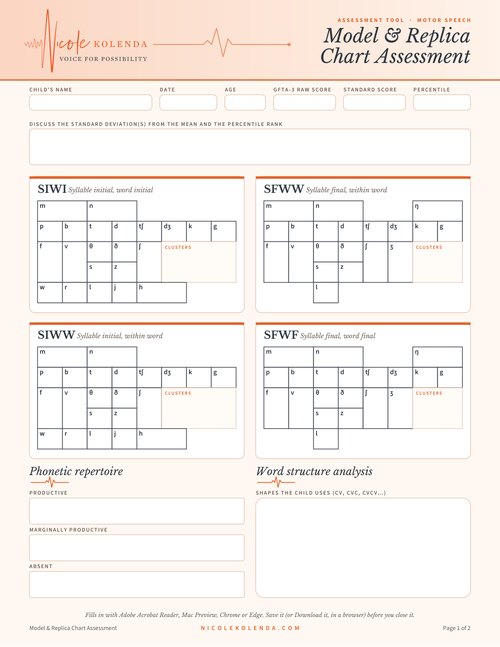
The first page of the Model and Replica Chart Assessment: test scores, the four syllable-position charts, phonetic repertoire and word structure

How to use it

Two pages, one child at a time

  1. Add the test scores

    Note the date, the child's age and the GFTA-3 raw score, standard score and percentile. Then discuss the standard deviation(s) from the mean and the percentile rank.

  2. Chart each syllable position

    Each sound has a box in all four positions, with a box for clusters. Record what you find for each one.

    SIWIinitial, word initialSIWWinitial, within wordSFWWfinal, within wordSFWFfinal, word final
  3. Sum up the phonetic repertoire

    List the sounds that are productive, marginally productive and absent.

  4. Analyze word structure

    Write down the word shapes the child uses: CV, CVC, CVCV and so on.

  5. Page two: vowels and key findings

    Add your vowel analysis, then your key findings by place, manner and voicing. The vowel and consonant charts are there for quick reference.

  6. Print it or save it

    Print the chart or save it as a PDF for your files. You'll be amazed how much you learn when you take the time to do an independent analysis of a child's skill level.

Swipe or use the arrows for all 6 steps

What you type stays in this browser tab. Nothing is sent or saved anywhere else, and closing the tab clears it. Identify the child by initials or a nickname, never a full name.

Fill it in here

The chart

Kept in this tab only. Saving makes one PDF with both pages: choose Save as PDF in the print window. Saved in this tab

Nicole Kolenda, Voice for Possibility

Assessment tool · Motor speech

Model & Replica Chart Assessment

SIWI Syllable initial, word initial

SFWW Syllable final, within word

SIWW Syllable initial, within word

SFWF Syllable final, word final

Swipe a chart sideways to see all of its boxes.

Phonetic repertoire

Word structure analysis

Model & Replica Chart AssessmentNICOLEKOLENDA.COMPage 1 of 2
Nicole Kolenda, Voice for Possibility

Assessment tool · Motor speech

Model & Replica Chart Assessment

Vowel analysis

Key findings

Quick reference

Vowels

Vowel chart: front to back, small to large mouth opening. iː heat, ɪ it, e bet, æ hat, a; uː hoot, ʊ hook, o, ɔ oar, ɑː hard; ɚ hunter, ɜː her, ə the, ʌ hut. Diphthongs: bait, my, out, boat, boy. FrontBackwhere in the mouth SmallLargemouthopening bait, datemy, sighout, boutboat, soakboy, soy iːuːɑːaeæoɔ(ː)ɪʊɜːɚəʌ heat, seathoot, boothard, hotbet, sethat, satoar, boarit, hithook, soother, birdhunterthe, ahut, butt

Consonants

MannerVoicingBilabialLabio­dentalInter­dentalAlveolarPalatalVelarGlottal
StopVoicelessptkʔ
Voicedbdg
FricativeVoicelessfθsʃh
Voicedvðzʒ
AffricateVoicelesstʃ
Voiceddʒ
NasalVoicedmnŋ
Liquid: lateralVoicedl
Liquid: rhoticVoicedr (ɹ)
GlideVoicedwj(w)

Obstruents: stops, fricatives, affricates. Sonorants: nasals, liquids, glides.

Model & Replica Chart AssessmentNICOLEKOLENDA.COMPage 2 of 2

Prefer paper or Acrobat?

Download the blank PDF

The same two pages as a fillable PDF. It fills in with Adobe Acrobat Reader, Mac Preview, Chrome or Edge. Save it (in a browser, use Download) before you close it, and your answers stay in the file.

Download the PDF 0.5 MB