April 26, 2023 · 14:27 · Cueing · Target selection
The Intrusive Schwa in CAS, With Dr. Julie Case
A lunchtime Instagram Live with Dr. Julie Case of the Case Speech Lab on the intrusive schwa in CAS: how it differs from epenthesis, her idea of "vocal inertia," and the cues and target choices that help a child stop cleanly.

Full transcript
Nicole: Take two. We're going to make this work, I know we are. Dr. Case was just having a little bit of difficulty getting in, and I'm hoping that starting Instagram on her end will help. So I'm going to hang out. Today it's Nicole from the NYU Motor Speech Lab, and we're coming in to talk about the intrusive schwa.
So for everyone coming in... there she is! Oh my gosh, yay. Sorry, everybody. Oh, Maria's here. Hi, Maria. Now we have to get her to come on live too. We'll make it happen. We're here now, and we're so excited to talk about the intrusive schwa. I'm going to give just a brief intro about what it is.
And I was saying earlier, the irony, Julie, is that my evaluation this morning had intrusive schwa all over the place. The timing is insane. Hi, everybody.
Okay, so very quickly: what is this intrusive schwa? It's when we hear the child insert that schwa in places where it shouldn't be. We know it's similar to epenthesis, where if the target word is "black," we might hear "buh-lack." A lot of times we'll hear it at the end of a word. One that I like: the target word is "stop," and you hear "stop-uh," right? I have a kid right now whose target word is "eat," and he says "eat-uh."
If we're thinking about phonological processes, I've always personally been particularly obsessed with epenthesis, because I find it really interesting that the child, like in the example "buh-lack," is actually making the syllable structure harder in order to manage both of the consonants in that word. They're telling us: no, both of the consonants are there, and this is the way I can do it. But we're not coming in to talk about epenthesis, right, Julie? We want to talk about how, when we see this in kids with CAS, it is not epenthesis. So take it away, Julie.
Dr. Case's theory: "vocal inertia"
Dr. Case: Yeah. Can you hear me? I'm not sure about my connection. Okay, beautiful.
I think we often hear the schwa and think it's epenthesis. I always thought of epenthesis as almost like a bridge: going from one consonant to another is just too hard, so you insert that bridge to get from a B to an L, or whatever it might be. But an inserted schwa is a whole different ballgame. For those of you watching who have this feature come up in your caseload, when you see it, you're like, oh, this is something interesting.
I've heard it between a vowel and a consonant within a word. Most frequently, though, I've heard it at the end of a word that ends in a vowel, and also, as you were just saying, Nicole, following a stop consonant. After a stop, it might be the excess effort being exerted for the stop plosive, especially with voiced phonemes, so you get that extra vowel added on. But my running theory, Nicole, and I feel like I'm going big by sharing this, because I've really only talked about it in conversation...
Nicole: Go big, go big.
Dr. Case: You know the idea when you're running along, and then you go to stop, but you need a couple of steps before you can stop? I feel like kids with CAS almost have this thing I like to call vocal inertia.
Nicole: You heard it here, folks: vocal inertia, by Dr. Julie Case.
Dr. Case: It's almost like all of the subsystems have come together, all of the speech motor systems are working together to produce a target, such as "me." And when they come to the end, everything needs to stop. But it's almost like the children are relaxing the articulatory subsystem, so their facial muscles relax, while the phonatory and respiratory systems are still going, so you still have that vocal stream. It's like when you're running really fast and you take a couple of extra steps to slow down. I feel like the schwa is those extra steps: kids with CAS can't stop all at once.
A system in motion needs to stay in motion, kind of an idea. The phonatory system's going, the respiratory system's going, the articulatory system is going. Well, when you completely relax your oral articulators, what position do you land in? You land in neutral. And which vowel is produced in neutral? The schwa.
So that's my thing that I see with kids: the schwa is the product of the articulatory system relaxing while the phonatory and respiratory systems continue. What I think we really need to teach our kids is, of course, to practice the initial articulatory gesture and smooth transitions throughout, but we also want to talk about "meet me here at the end," so that they hold that position and don't release into the schwa.
Cueing a clean ending
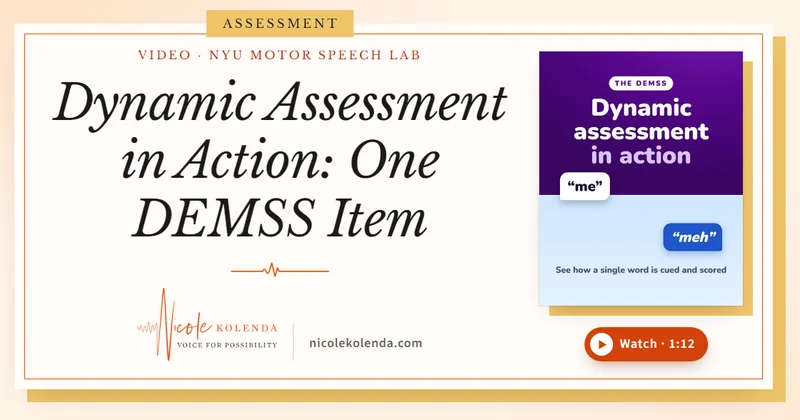
Nicole: So like today, like you were mentioning, the target word was "mommy" on the DEMSS, and the child said "mommy-uh." So what you're saying, Julie, is we know "mommy" ends in "ee." So you're going to say, "We're going to end this word here, 'ee,'" talk about it, and then go through it in slow simultaneous production, "mom-my," and end here. That's what you're saying?
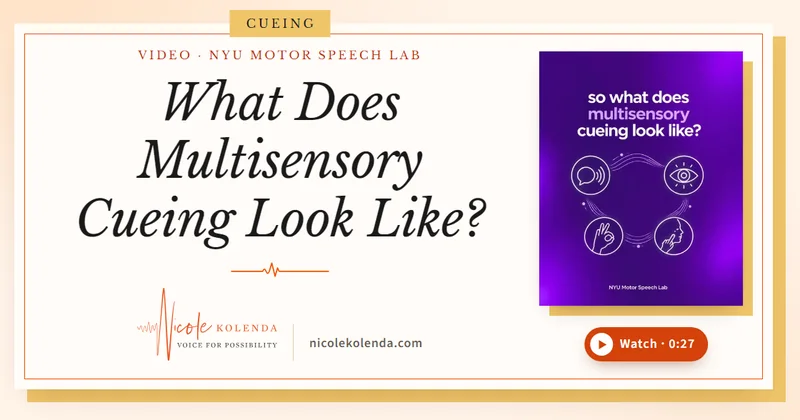
Dr. Case: Yeah. So, Nicole, I would say to you, "Okay, we're going to start here. Let's say it together. Follow my mouth, and meet me here at the end. Let's do it: 'mommy.'" And I'll even give a quick point to my mouth at the very end to show them. It's tricky, right? Because you also don't want to overcomplicate it with all of these directions: close the lips, open the lips, close them, hold.
Nicole: Well, I can tell you what I've been doing with "eat." He would either say "ee" or "ee-duh" or "ee-tuh," right? I've gone to a slow simultaneous whisper, and I give him a light tap at the end, like this: "eat." And we have it in slow simultaneous whisper for that word. I keep trying to tease the voicing back in, and he's somewhat there. It's still really hard, so we're really working on that.
Dr. Case: You know, Nicole... go ahead, excuse me.
Nicole: No, no, go ahead.
Dr. Case: Sometimes I feel like, at the end of the day, it's also practicing at that slow rate of speech, giving them the time to move slowly with you and to really feel it. And you're so incredible with the feedback you give kids. Guys, if you want to see a master at work, watch Nicole give feedback: "Did you feel that? Did you feel that?" Having them really move and feel it is another way you don't have to overcomplicate your verbal feedback. Just "eat," and feel the light touch at the end.
A clinical decision: end in a continuant
Nicole: One of the things Julie and I were talking about yesterday was why we picked this target word for this little boy. He has a preference for open syllables, so we really wanted closed syllables in our target selection. In the lineup I started out with, I had "eat," "peep," "hi," and "mine."
And I'm just going to share with you a clinical decision that I made. I was having such a hard time with "eat" and that intrusive schwa. T and P are both voiceless stops, and he was doing the same thing with "peep": I was getting "peep-uh." So I took "peep" out, kept "eat," and put "mine" in, because ending in a continuant is easier. I'm still working on the CVC structure this kid so badly needs, but having it not end in a stop consonant is so much more helpful, right, Julie?
Dr. Case: Yeah, because the stop consonant so naturally lends itself to that, because you close and you release. And these kids are exerting so much effort in their productions that, with my vocal inertia, the voicing just wants to keep going all the way through afterward. So I think it's brilliant, Nicole. If you're working on closure and you're seeing the insertion after the final consonant, start with a continuant.
Another thing I think is really great: of course, giving them the tactile cue to keep that closing gesture at the end can help. But I also think about the visual model, giving the kids the gesture so they can understand where you're going, like "eat" or "mine," so they can see: this is where I hold it. But then we also want to make sure we're giving them a natural model, because that could go awry in all of this. There are so many things to think of.
Nicole: It's so hard. And the one thing I always do is tap: "eat." Some kids do well with that. Some kids are like, what do you mean? Or I touch them too hard, and then they're mad at me, and I'm like, I'm sorry.
When a child can't stop at the end
Dr. Case: I know. So I think using that slow speech and letting it work for you, like you said, is so great. And turning off the voicing. And that's where I like "meet me here at the end," giving them a clear stop, so they know this is where it's going to end, whether it's "eat" or "me."
I'm working with a child who has a different form of inertia, I'd like to say. She adds extra productions at the end of a word, and I've seen it with all different sounds. So I was having her meet me at the end, but then I realized that was just supporting her to keep going at the end. So now I'm trying to bring her to a neutral gesture, and that seems to help. But you've got to be careful. It's like, how can we get those subsystems to efficiently stop at the end? I think that's really what I often think about.
Nicole: This has been so awesome, Julie. And everyone listening: this is the first time we're calling it vocal inertia, Dr. Case's terminology, so be on the lookout for research. She hopped in here and commented that she loves "vocal inertia."
Dr. Case: Because I think I've really only used it with you or Maria, maybe Edy too.
Nicole: We constantly talk about the intrusive schwa, which is why we wanted to come in. We're always talking about it, so I wanted Julie to share her thoughts on it with you, because I think it's brilliant. I'm so excited to do this with you, and maybe we could do it more often. If anyone watching has other things you'd like us to talk about, we could do this a little more frequently. This way you're not only seeing my face on the screen; I'd love to have Julie with me. So we'll sign off. Julie, do you want to say anything else before we close?
Word-final disfluencies?
Dr. Case: No, just any ideas or suggestions. It's fun to talk, Nicole. It's so true, we talk about this stuff all the time, so it's fun to share our inner conversations with the outside, because I think it's fruitful.
Sometimes it's the wording. I don't know who attached this wording to it, and I wouldn't want to use anyone's name, but some of those sounds get described as "bouncy sounds," and I wonder if that's part of why she has that bouncy bit to her. Another thing I'm thinking of: in the fluency literature, there's this teeny, tiny body of literature that talks about word-final disfluencies. I wonder if there could be a word-final disfluency piece to this. Haley, you know Haley, is very interested in this, and now I'm thinking I should probably talk to her about it.
Nicole: Okay, well, maybe we can talk about that at another point. Thank you, everybody, for coming in on your lunch break to spend time with us. I'm going to post the video so you can have access to it over and over again. Julie, I hope we can do this again. Everybody have a wonderful Wednesday.
Dr. Case: Thanks, Nicole, for having me. Take care, everybody. Bye.