December 4, 2023 · 1:59 · Cueing · Making the shift
Key Elements of Practice, Part 3: Multimodal Cues for Movement
Hand shapes, a reinforcer held at mouth level, tactile cues and syllable tapping: multimodal ways to keep a child's attention on movement.

Full transcript
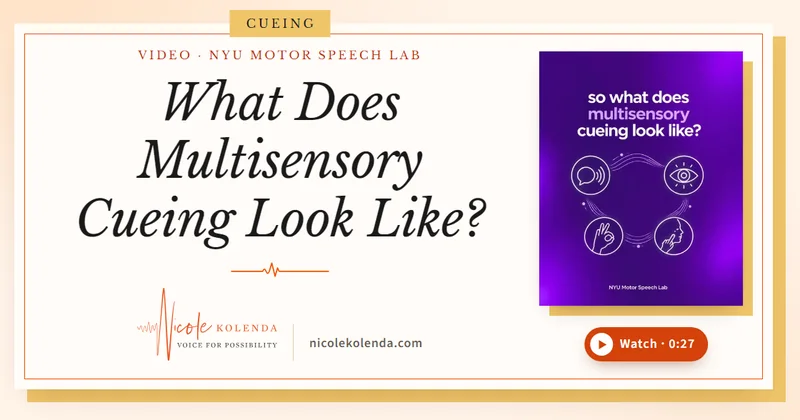
Hi, it's Nicole from the NYU Motor Speech Lab, and we're on day three talking about the key elements of practice, which were developed by the Case Speech Lab and the NYU Motor Speech Lab. The first one, we said, was structured practice. The second one, one of my favorites, was conscious practice. And the third one is using multimodal cues to focus on movement.
So what does that mean? One of my favorite things to do is take my hand and say, "Okay, here's your mouth. The target word is 'me.' So you're going to bring your lips together. Look, I'm bringing your lips together. 'Me.' And then we're bringing your lips back, and we're seeing our teeth. 'Me.'"
Another thing I like to do is grab a reinforcer. Good old Blippi. Bring it up to the level of your mouth so that you know they're looking here. The looking here is the most important part; eye contact doesn't matter so much. We want them to look at the movement. I like to use this type of item to show the rounded vowels: "show, show." That way they can really understand that their lips are coming out, and I'll even pretend I'm pulling their lips out.
This is another good time when you could absolutely use the PROMPT technique and go in with your tactile-kinesthetic cues, if they'll let you. I have a couple of kids who don't want me to touch them. So what I do is touch myself and focus on where I'm feeling it on myself: "go." And then sometimes they do the same thing to themselves.
Again, the big key here is to use multimodal cues to get them tuned in to movement and to moving through the word. Sometimes, for a two-syllable word, I'll also tap it out: "O-pen. O-pen. Open." That way they can get used to that and what it feels like.