April 2, 2024 · 1:41 · Cueing · Target selection
Backward Chaining for Multisyllabic Targets
For long target words with older kids with CAS, practice the end of the word first, like “cato” in avocado, and always finish the block with the full word.

Full transcript
Hi, it's Nicole coming in from the NYU Motor Speech Lab. Happy Monday. I'm coming in to answer a quick question about working with longer targets for older kids with CAS, where you're choosing multisyllabic words as targets, which can be incredibly impactful for the child.
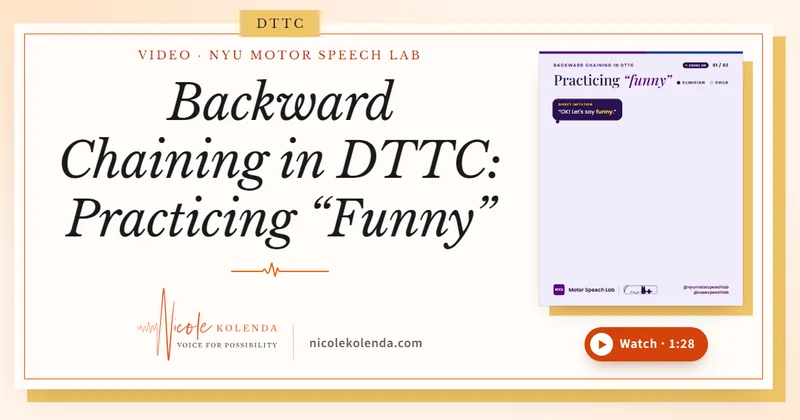
One of the things we do in this type of therapy is called backward chaining. Take the word "avocado," which is a word we like to use in therapy. Something I might do with "avocado" is start with "cato." I have a child right now for whom the velar is a little challenging, and the lip rounding for that final vowel isn't quite there.
So I'll let them know we're going to work on "avocado," and I'll give them a really good model of it. We'll try it a couple of times, and then I'll say, "Okay, let's start here. 'Cato.' Say that with me: 'cato.'"
The one thing you always want to do when you're backward chaining is to not end the block without bringing it back to the full word, so that they remember what they were working on. With "pajamas," a lot of times that "ja" is a little challenging, so I'd break it down into "jamas, jamas, jamas." Then at the end of the block, bring it back to the full word: "Okay, let's say the full word. Meet me here: 'pajamas.'" That way they know what we were working on. The same with "avocado": "Meet me here: 'avocado.'" Then they can see where the piece fits into the bigger word.
I hope that's helpful.