October 9, 2024 · 1:38 · Cueing · Assessment
How to Choose Which Cues to Use
Dynamic assessment with the DEMSS shows which cues work for a child. Nicole's go-to cues: her hand for mouth opening, "meet me here" for integral stimulation, and touch for word-final consonants.

Full transcript
Good morning. It's Nicole from the NYU Motor Speech Lab, and this week we're talking about cueing. I get a lot of questions about how you know which cues to use.
Hopefully you've done a dynamic assessment with this child beforehand to diagnose CAS, looking for those observable characteristics. We love the DEMSS here, developed by Dr. Edythe Strand. In that dynamic assessment, when the child doesn't say the target accurately twice in a row, you're able to cue up to six times. So as the diagnostician, who will hopefully become the clinician, you're learning in that moment what works for the child: which cues get them closer to the target, and also which cues they don't like. Some kids don't like to be touched. Some kids might not want tactile cueing.
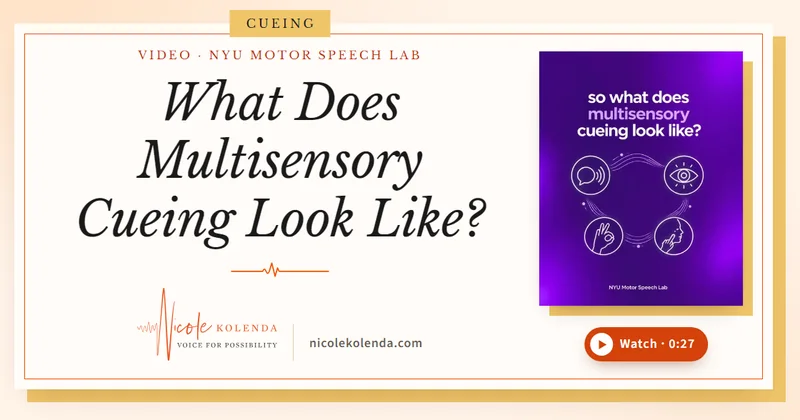
What I've learned works really well is using my hand to represent mouth opening, and you'll see this in a lot of the videos. I'll say, "Here's your mouth. We have to go really big for 'my,'" or bigger for "I," and bring it back down. I use that to show jaw opening.
Another thing I like to do is have them look at me: "Meet me here." We're building on integral stimulation. We're not using a mirror in this therapy; in traditional articulation therapy, of course, but in this therapy we want them looking here, at us. We don't even care about eye contact. It's here, at the mouth. So I'll say, "Meet me here, and move with me."
Another thing I find helpful, if I'm working on a closed syllable shape like a CVC: say the target word is "mine." I'll go down their arm, "mine," and touch at the end so they can feel the ending.