December 8, 2025 · 4:06 · Cueing
Using Tactile Cues in Motor Speech Therapy
After ASHA, Nicole shares how she uses tactile cues: ask permission first, then use touch to close a CVC word, tap out syllables, and show pressure differences, such as for a child with an intrusive schwa.

Full transcript
Hi, it's Nicole coming in from the NYU Motor Speech Lab, and this is my first video post-ASHA. I just quickly want to say it was awesome to meet so many of you in real life, and we are so deeply appreciative of everyone who came to our talk on Friday morning at 8 o'clock. We even had an overflow room, so thank you.
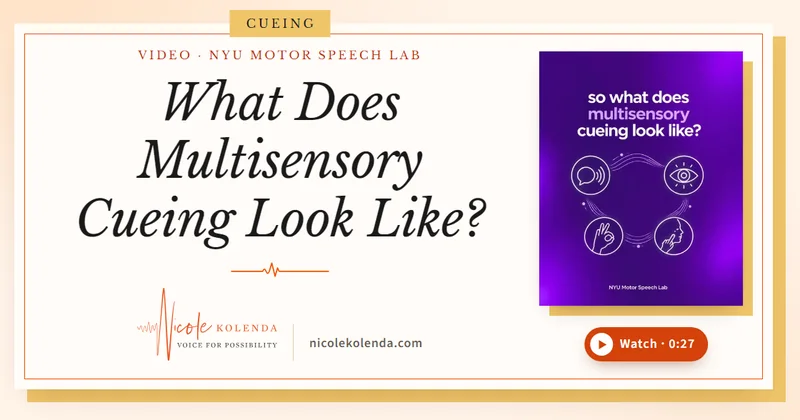
One of the things I wanted to talk about, because it was really well received at the talk, is tactile cueing and using it in your pediatric motor speech therapy. We have our proverbial toolbox that we bring to our motor speech therapy sessions, and we are using all the cues to help this child say the target word. One of the cues I love in this type of therapy is tactile cues. So let's get to it.
Before you even use a tactile cue, you want to make sure the child is okay with you touching them. How do we do that? We ask for permission: "Is it okay if I touch your arm?" Something I do is show them on my own arm what I'm going to do or where I'm touching. I'll also take their hand and have them do the cue on me first, just to illustrate what it's going to look like and what it might feel like. So first things first: before any type of touching, make sure you get permission.
Then, two of the cues I love and use frequently. The first is for a CVC word. If the child has a preference for open syllable shapes, ending in a vowel, and you're purposely choosing a CVC target like "home," I take their arm and start at their shoulder. I say "home," moving down the length of their arm for the vowel, and at their wrist I push in, closing the CVC, so they can really feel the final consonant. This is really successful.
Another thing I do is tap out syllables. Let's say "banana": start up here, and tap "ba-na-na."
One more thing I really like to use tactile feedback for is showing pressure. Say you have a word like "pop" or "dad," where the initial sound, although it's the same phoneme, has a little more pressure than the final one. This is particularly for the child who is adding an intrusive schwa, so "dad" might become "dada." For "dad," sometimes I ask if I can push in on their tummy. For the initial "d," I start here and push harder, and the final "d" is just a tap, which is light. And I'm talking about that as I'm doing it. Remember, when we think about the motor plan, planning that pressure is a whole other plan in there: getting the accurate pressure for the phoneme.
Something else I do: say the target word was "open," and the child is getting the tongue there, but they're not pushing enough. I'll say, "Your tongue is in the right spot, but can you push just a little bit more? Open." And I push so they can actually feel it.
This has been really successful in my motor speech therapy sessions. I hope this is helpful.