January 22, 2024 · 2:00 · Assessment · Cueing
Dynamic Assessment for CAS: How the DEMSS Works
Why dynamic assessment matters when you suspect CAS: cue the child up to six times, take a final uncued try for a consistency measure, and learn which cues work.

Full transcript
Hi, it's Nicole coming in from the NYU Motor Speech Lab, talking dynamic assessment. I have here the DEMSS; this is what we use. It was developed by Dr. Edythe Strand, and it's the only dynamic assessment tool on the market right now. That doesn't mean you can't take the concepts of dynamic assessment and apply them in your own assessment too. This is just what we use to get a score, and it's super helpful.
So what actually is dynamic assessment, and why is it so important to use it when you suspect CAS? Dynamic assessment allows the clinician to cue the child to get the target. The child says the target at least twice, and if they get it accurate, you keep it moving and go on to the next target.
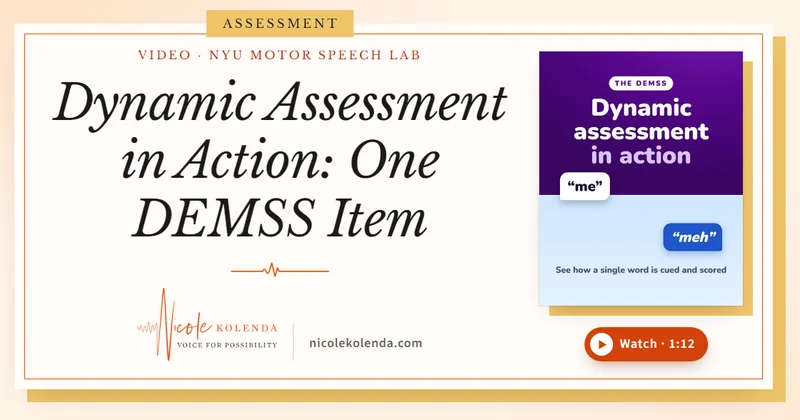
In the DEMSS, the targets are grouped by syllable shape. We have easier syllable shapes, like V, CV and VC, and then we go up to harder shapes, like CVCVCV. If the child gets it wrong, you're allowed to cue them up to six times. So you reach into your proverbial SLP toolbox and use all the cues you have at your disposal, PROMPT, gestural cues, and you try to get the child to say the target word.
Then you pull back on the very last one, the sixth one, and have them say it without the cueing. That gives you what's called a consistency measure: was this final attempt, after all the cueing, the same as the initial attempt? That's super helpful information to have.
So why do we need this? It allows us to observe the characteristics we need to see to identify CAS, which we've talked about before. And it also gives us, the treating clinicians, such wonderful insight into which cues are going to work for this child, and which aren't.
I hope that's helpful.