February 20, 2026 · 2:38 · Engagement · Practice
The Parking Lot Method for Conscious Practice
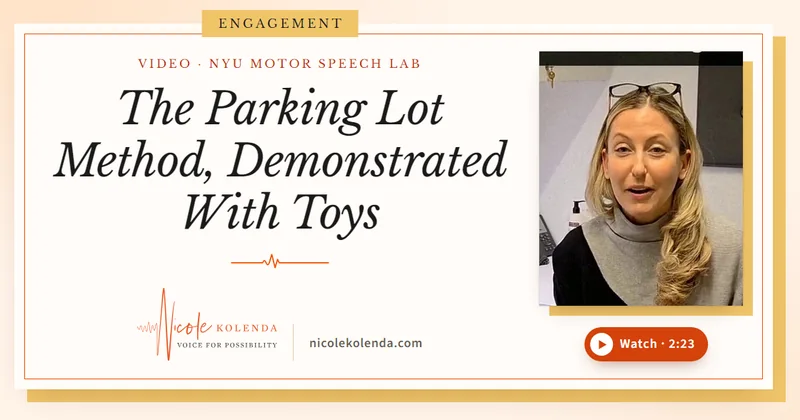
Nicole's parking lot method: young children earn a toy character after each block of practice, then the character goes to the parking lot, so play waits and attention stays on the clinician.

Full transcript
Hi, it's Nicole coming in from the NYU Motor Speech Lab. We're always talking about targets and your sessions, and I've talked before about my parking lot technique when doing treatment. So what exactly does that mean?
We know that in pediatric motor speech therapy, we want the child to be focusing on conscious practice. When you're in a block of training, targeting the same word over and over again with multisensory cueing, you want the child to really be focusing on your face. We call that integral stimulation. So how do I get young kids to come into a session and actually engage in conscious practice with targets that are hard?
Here's one way, and I call it the parking lot method. I have a new little boy I'm working with, and he loves SpongeBob. So I got this awesome SpongeBob ship. I can't wait to show him. It came with six different characters.
So I'll say to him, "Hey, I'm so excited! We're going to play with our SpongeBob ship," and I'll show him. Then I'll say, "We're going to work on a word, and then you're going to pick the character you want to play with. By the time we get all six, we'll be able to play with the ship together." Maybe I'll say, "Okay, who should we work for first? SpongeBob? Look, isn't he cute?" We'll do our word in our blocked practice. Then I give him SpongeBob and let him look at him, hold him, and talk about him. Then I'll say, "Okay, let's put SpongeBob in the parking lot." Maybe the parking lot is just a designated area over here. Now we work for another character: we say our word, and we do the whole thing again. We do it six times, and then we have time to play.
The reason is that we cannot get real conscious practice if the child is engaged in play and not paying full attention to you. I hope that's helpful.