Voice for Possibility
What is DTTC?
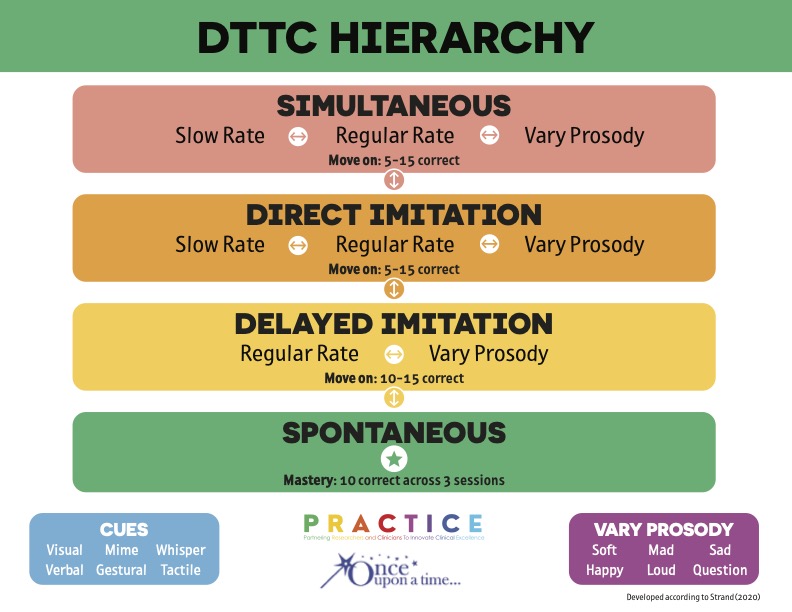
- Dynamic motor-based treatment developed by Dr. Edythe Strand (2020) and based on Integral Stimulation
- Designed for children with moderate to severe CAS
- Focuses on the refinement of speech movements and shaping of accurate movement gestures
- Incorporates Principles of Motor Learning at all stages
What is the Goal of DTTC?
Improve the efficiency of neural processing to:
- Develop and refine motor planning and programming, especially the specification of movement parameters
- Provide strategies to enhance generalization and habituation
How does it work?
Through repeated practice, DTTC aims to develop and refine speech motor programs by:
- providing clear and accurate auditory and visual models
- shaping movements through slowed rate, visual and tactile cues
- adding and fading cues, as needed
- providing specific feedback about the movement early on (Knowledge of Performance, KP), then fading to Knowledge of Results (KR) to facilitate learning and retention.
How do you organize your sessions to maximize your client’s potential?
To Consider:
- Practice Amount: How much is enough?
- Length of Sessions: shorter vs. longer
- Random vs. Blocked practice
- Mass vs. Distributed practice
To Remember:
- DTTC is a treatment designed for moderate to severe CAS adhering to this paradigm shift of focusing attention on movement rather than the sound in treatment.
- Prosody should be practiced from the start of therapy—it is not an afterthought.
- The focus should be on positive not negative practice—once a child begins to produce a target incorrectly-the therapist immediately intervenes.
*It is essential to have conscious awareness of how you move your jaw, lips and tongue as you model words.
Where can I learn more?
Research
- Strand, E. A. (2020). Dynamic Temporal and Tactile Cueing: A treatment strategy for childhood apraxia of speech. American Journal of Speech‑Language Pathology, 29(1), 30–48.
- Grigos, M. I., Case, J., Lu, Y., & Lyu, Z. (2024). Dynamic Temporal and Tactile Cueing in young children with childhood apraxia of speech: A multiple single‑case design. Journal of Speech, Language, and Hearing Research, 67(4), 1042–1071.
- Grigos, M. I., Tampakis, P., Wang, E. W., Kolenda, N., Strand, E. A., Wambaugh, J. L., Lu, Y., Lyu, Z., & Case, J. (2025) ASHAWIRE: A Framework for Measuring Treatment Fidelity in Motor-Based Speech Intervention for Children With Childhood Apraxia of Speech
I’m so excited to share my 3 FAVORITE Childhood Apraxia of Speech (CAS) Resources—from differential diagnosis to goal writing and treatment. Use this guide for efficient clinical planning, goal writing, and implementing effective motor-based speech therapy for children with CAS.
Grab your free gift now!